Micro CNC machining covers parts and features small enough that normal shop assumptions stop holding. A tool that barely deflects on a standard part can bend measurably at a fraction of the diameter. A fixture that clamps a bracket without a thought can crush a thin micro-scale wall. This guide explains what counts as micro machining, which industries actually need it, what makes it harder than standard-scale work, and what drives its cost. It closes with a short pointer on when a part calls for a different capability altogether.
What Counts as Micro CNC Machining
There is no single line that separates “micro” from “standard,” but the practical marker is scale relative to tolerance. Micro CNC machining generally means parts or features measured in sub-millimeter to a few millimeters, with positional and dimensional tolerances held tight relative to that small size.
Micromachining is a process for producing three-dimensional miniature parts across metals, alloys, polymers, composites, and ceramics, with achievable accuracy running considerably finer than what conventional-scale machining delivers. Micro-cutting is kinematically similar to ordinary milling and turning, but it behaves fundamentally differently in practice once the cutter and the feature both shrink. Smaller does not mean simpler. It means different physics govern the same basic operations.
Why Micro-Scale Parts Are Harder to Machine
Four problems grow faster than part size shrinks. None is unique to micro work, but each becomes the dominant risk rather than a background concern.
Tool deflection and breakage. An end mill acts as a cantilevered elastic beam, fixed at the collet and free at the cutting end. Beam stiffness scales with the fourth power of effective diameter and falls off with the cube of the length sticking out from the holder. Halving a cutter's diameter therefore does far more damage to its stiffness than doubling its overhang does. Small-diameter tools flex more under the same cutting force, and that flex shows up directly as a form error on the finished wall.
Workholding and fixturing precision. Standard vises and clamps are built to hold stock steady, not to protect a fragile feature from the clamping force itself. Fixture designers use slot clamps and similar devices specifically because thin workpieces need a different holding strategy than bulk stock. On a micro part, the fixture has to hold the piece rigid enough to machine accurately without ever approaching the force that would distort it.
Thermal and vibration sensitivity. Small features carry little thermal mass and little structural stiffness, so they respond faster and more visibly to heat and vibration than a larger part would. This follows directly from the same deflection and stiffness relationships above.
Metrology. Measuring a feature accurately gets harder as the feature gets smaller. Alignment errors on a small datum feature do not shrink with the feature. They amplify through the rest of the measurement. A tiny error aligning a small end face can produce a large error further down the part. The guidance is to avoid using a small feature as the primary alignment datum wherever a larger, more stable surface is available.
| Consideration | Standard-scale machining | Micro-scale machining |
|---|---|---|
| Tool deflection | Manageable at normal diameters | Dominant risk; stiffness drops sharply as diameter shrinks |
| Workholding | Standard vises and clamps | Needs holding force tuned to avoid crushing the part |
| Thermal / vibration | Background factor | Direct, visible effect on the finished feature |
| Metrology | Routine gauging | Alignment error amplifies; datum choice matters more |
Where Micro CNC Machining Shows Up
Micro machining earns its cost where the assembly has no room for a larger part or a looser tolerance. Common industries include:
- Electronics: connector pins, small enclosures, contact hardware
- Medical devices: instrument components, small housings, precision fittings
- Watch and instrument components: miniature shafts, gears, and cases
- Small precision hardware: fasteners, bushings, and fittings built to tight positional tolerance in a small envelope
This is the same territory covered on the site's own micro-part capability page, which frames micro work as a stability problem as much as a size problem: controlling deflection, workholding, and edge condition on parts where a small mistake consumes the whole feature. Materials commonly specified for this work include stainless grades, brass, aluminum, and titanium, chosen for conductivity, magnetic properties, or corrosion resistance as the application requires, not for machinability alone.
What Micro Parts Actually Cost
The honest answer to how much it costs to manufacture small parts is that cost per part is often higher than the raw material would suggest. Small size does not mean small price.
A tiny part still needs a program written, a fixture set up, a first article inspected, and every feature measured before it ships. Setup, tooling, and inspection time do not shrink at the same rate the part does. They make up a larger share of the price on a small part than on a large one.
Tight tolerance compounds this. The site's precision capability is ±0.01 mm, against a standard shop tolerance of ±0.05 mm for work with no individual callout, following ISO 2768 as the general reference standard. Holding a small feature near the tighter end of that range adds slower finishing passes and more inspection time relative to the part's size. The same cost drivers are covered in the site's own CNC machining cost guide.
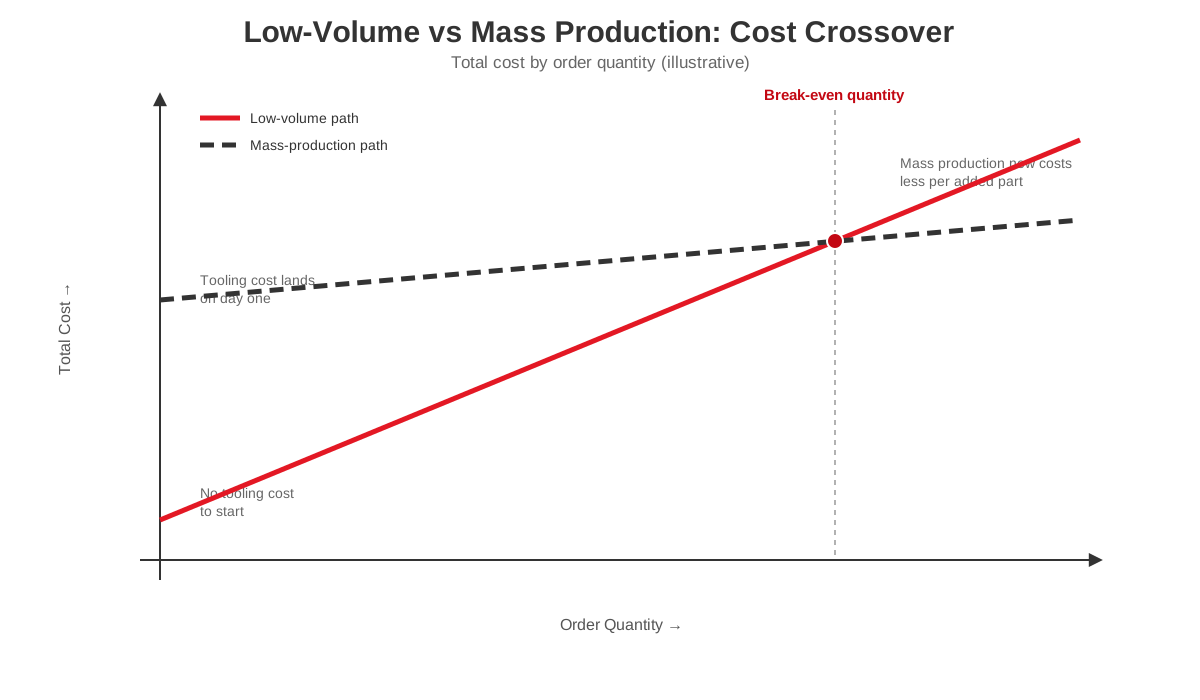
Quantity still matters as much as it does on any other part. Setup cost is fixed per job and spreads across the batch. A single prototype carries the full weight of programming and fixturing, while a production run divides it across many parts. Micro-part quotes here run under a no minimum order quantity policy, from a single prototype through to full production.
Which Capability Fits the Part
Not every small-looking job is a micro job, and not every large job is only about size. When a part is tiny and the tolerance is tight relative to that size, micro machining is the right lens, with fixturing, tooling, and inspection scaled down to match.
When the part is large or heavy instead, a different set of problems takes over: machine travel, fixture stability across multiple setups, and datum control across a bigger envelope. That is covered separately on the large-part machining capability page. The two capabilities solve different problems and rarely overlap on the same drawing.
What to Send for an Accurate Micro-Part Quote
A useful RFQ for micro work includes a 3D model (STEP preferred) and a 2D drawing calling out critical tolerances. It should also list material and grade, quantity, required finish, and any cleanliness or handling requirements tied to electronics assembly. Marking which dimensions are genuinely critical, rather than tolerancing everything tightly by default, keeps the quote realistic and avoids paying for precision the part does not need.
Send a small-part drawing for a scoped quote — get a quote.
Frequently Asked Questions
Where to buy small CNC parts?
Small CNC parts are sourced directly from a CNC machining supplier rather than a generic parts catalog, since most small components are custom to a drawing. A STEP file and 2D drawing sent to a shop with micro-part experience is the fastest route to a real quote, rather than searching for a stock part that happens to fit.
What is CNC micro machining?
CNC micro machining is computer-controlled cutting of very small parts or features, typically sub-millimeter to a few millimeters, where positional and dimensional tolerance is held tight relative to the part's size. It uses the same milling and turning principles as standard CNC work, but tool deflection, workholding, and measurement all behave differently at that scale.
What is the cost of CNC manufacturing small parts?
Cost per part is often higher than the raw material cost would suggest, because setup, tooling, and inspection time do not shrink at the same rate as the part. Tight tolerances add finishing and inspection time on top of that. A real quote depends on material, tolerance, quantity, and finish rather than one flat rate.
What are CNC estimating tools for micro manufacturers?
Most CNC estimating tools build a price from stock size, estimated cycle time based on feature count and tolerance, and setup cost divided by quantity. For micro parts these estimates are less reliable than for standard-scale work, since setup and inspection make up a larger share of the price. A drawing sent for a direct quote gives a more accurate number than a generic estimator.