Choosing between 304 vs 316 stainless steel for a machined part? The grade you put on the drawing moves corrosion life and cost before you ever request a quote.
Most stainless RFQs name 304 or 316. SSINA's Stainless Steel for Machining identifies better chloride corrosion resistance as 316's advantage, while Machinery's Handbook reports matching nominal annealed strength for both grades. So the decision is about corrosion exposure, welding, and machinability, not strength. The sections below work through each factor, including where free-machining 303 fits, so you can choose the grade and material standard for your drawing. When you're ready, send it through our stainless steel machining page.
What Is the Main Difference Between 304 and 316 Stainless Steel?
The main difference between 304 and 316 stainless steel is molybdenum. Machinery's Handbook, 31st edition, Table 6, lists 316 (UNS S31600) at 2.0–3.0% molybdenum and 10–14% nickel, with no molybdenum in 304 (UNS S30400) and nickel at 8–10.50%. UNS is the Unified Numbering System name for the grade.
These typical composition ranges are what you check against the standard named on your print.
| Grade (UNS) | Chromium (%) | Nickel (%) | Carbon max (%) | Molybdenum (%) |
|---|---|---|---|---|
| 304 (S30400) | 18–20 | 8–10.50 | 0.08 | none |
| 304L (S30403) | 18–20 | 8–12 | 0.03 | none |
| 316 (S31600) | 16–18 | 10–14 | 0.08 | 2.0–3.0 |
| 316L (S31603) | 16–18 | 10–14 | 0.03 | 2.0–3.0 |
Note that chromium in 316 runs 16–18%, lower than 304's 18–20%. 316L keeps the chromium, nickel, and molybdenum of 316; only the carbon cap drops, from 0.08% to 0.03%. Stainless Steel for Machining, Table II, matches these ranges for 304 and 316.
The grade mapping matters because standards differ. The Atlas Technical Handbook of Stainless Steels maps 316 to EN 1.4401 and 316L to EN 1.4404. BS EN 10088-2:2014, Table 1, caps molybdenum in both at 2.00–2.50%, so a heat at 2.6–3.0% meets the AISI range but exceeds the EN cap. MIL-HDBK-5J says the molybdenum in 316 is "added to improve corrosion resistance in reducing environments". That corrosion role leads directly into the 316L question.
Is 316L Different From 316 Stainless Steel?
Yes, 316L differs from 316 in its lower carbon cap, which supports corrosion resistance after welding. Machinery's Handbook lists carbon at 0.03% maximum for 316L versus 0.08% for 316, with matching chromium, nickel, and molybdenum ranges. MIL-HDBK-5J describes 316L as the "Low-carbon modification of Type 316 for welded construction".
Will your machined part be welded into an assembly, and does it include heavy sections? Atlas Grade Datasheets identifies 316L for resistance to sensitization in heavy-gauge welded parts, about 5 mm and over. Sensitization means chromium depletion at grain boundaries after chromium carbides form, leaving those boundaries open to corrosion. The Atlas Technical Handbook places this process at about 425–850 °C, including slow cooling through that range after welding. It favors 316L for resistance to intergranular corrosion in heavy-section welding.
Strength tells a different story. Machinery's Handbook gives 316 nominal annealed tensile and 0.2% yield strengths of 85,000 psi and 35,000 psi, against 78,000 psi and 30,000 psi for 316L. So specify 316L for the welding route, not for strength, and keep the separate question of in-service corrosion for the next section.
Which Grade Resists Corrosion Better, and When Does It Matter?
316 resists chloride corrosion better than 304. Guidelines for Nickel Stainless Steels for Marine Environments, Natural Waters, and Brines describes 304 as satisfactory for long-term water handling below 200 ppm chlorides and marginal up to 1000 ppm. It prefers 316 for critical uses above 200 ppm. These are water-service guidelines, not universal acceptance limits for your part.
Will chlorides reach your component? IntechOpen's Stainless Steels and Alloys explains that molybdenum and chromium stabilize the protective surface film in chlorides. Molybdenum also increases resistance to the initiation of pitting and crevice corrosion.
Can 316 Still Corrode in Seawater?
Yes, 316 can still suffer crevice attack in seawater, according to the Nickel Institute marine guidelines. The same guidance considers crevice incidence too high for condenser or heat-exchanger tubing except for temporary service. A 316 callout therefore still needs a review of the actual exposure and any crevices in your design.
Published immersion results show why that qualification matters. Resistance of Stainless Steel to Corrosion in Naturally Occurring Waters reports these fully immersed seawater results in Table VII.
| Grade | Reported Attack After Three Years | Reported Perforation |
|---|---|---|
| 304 | Perforation through 3.15 mm | By year 3 |
| 316 | Maximum attack of 1.51 mm | By year 7 |
Those results describe one reported exposure, not your component's service life. High-Performance Stainless Steels separately reports critical crevice chloride concentrations of about 2.5 molar for 304 and 4.0 molar for 316. These describe crevice initiation conditions, not allowable chloride levels for a drawing.
What Do the PREN Figures Tell You?
PREN, the pitting resistance equivalent number, compares alloy composition for pitting resistance. Stainless Steels for Lecturers and Students calculates it from chromium, plus 3.3 times molybdenum, plus 16 times nitrogen; nickel plays no part. The same source reports PREN bands of 17.5–20.8 for 304 (EN 1.4301) and 23.1–28.5 for 316/316L (EN 1.4401/1.4404). Use the bands alongside the service evidence, since a single rounded value hides real composition variation.
Corrosion is where 316 earns its premium. Strength is not, as the next section shows.
How Do 304 and 316 Compare on Strength and Hardness?
Annealed 304 and 316 match at 85,000 psi tensile strength, 35,000 psi 0.2% yield strength, 55% elongation in 2 inches, and 80 HRB (150 BHN), according to Machinery's Handbook, Table 12.
The Machining and Metalworking Handbook reports matching ASTM strength and elongation minima for annealed 304 and 316, with different hardness maxima.
| Property, Annealed Condition | 304 | 316 |
|---|---|---|
| Tensile strength, minimum | 515 MPa (75 ksi) | 515 MPa (75 ksi) |
| 0.2% yield strength, minimum | 205 MPa (30 ksi) | 205 MPa (30 ksi) |
| Elongation, minimum | 40% | 40% |
| Hardness, maximum | 201 HB / 92 HRB | 217 HB / 95 HRB |
A hardness maximum is a limit, not a typical value. The higher maximum for 316 doesn't establish that your 316 part will be harder than a 304 part.
These annealed figures give no support for specifying 316 as a strength upgrade. Its advantage is chloride resistance from molybdenum. That leaves one practical question: which grade costs you more at the spindle?
Is 304 or 316 Harder to Machine?
On published ratings, 304 and 316 machine about the same. USAF TO 1-1A-9, Table 2-7, rates both at 40% machinability against B1112 screw stock at 100%, with 303 at 65%. The table is "only intended as a starting point."
A separate classification does split them. Machining the Austenitic Chromium-Nickel Stainless Steels places 316 and 316L in Group 3, its hardest group, and 304 and 304L in Group 2. Neither comparison is a measured cycle time for your part, so neither establishes a machining-cost premium for 316.
Both grades share the behaviors that make stainless demanding. Stainless Steel for Machining describes high work-hardening rates and recommends a positive feed without dwelling to avoid glazed, hardened surfaces. USAF TO 1-1A-9 names "seizing, galling and stringing" as difficulties. It advises "slow speeds and heavy feed," with sharp edges and no riding of the tool on the work. These practices apply equally to both grades, which is why the real machining choice is 303.
Where Does Free-Machining 303 Fit, and What Do You Give Up?
303 fits parts where machinability takes priority and corrosion exposure is minor. What you give up is corrosion resistance and weldability. Role of Stainless Steels in Desalination gives pump shafts as an example of this limited use and advises against 303 for other brine-exposed parts.
MIL-HDBK-5J describes 303 as a "Free machining sulfur modification of Type 302", and Stainless Steel for Machining specifies sulfur at 0.15% minimum for 303, UNS S30300. Sulfur reduces tool-chip friction and helps chips break, which is where the speed comes from.
| Grade | Machinability Rating, B1112 = 100% |
|---|---|
| 303 | 65% |
| 304 | 40% |
| 316 | 40% |
The trade-offs run both ways. Atlas Grade Datasheets puts 303's corrosion resistance below 304's, and the Atlas Technical Handbook identifies reduced formability and weldability as the compromises for machinability. MIL-HDBK-5J states, "The free-machining grades are not recommended for welding". If those compromises don't fit your part, the remaining lever is cost.
What's More Expensive, 304 or 316?
316 is more expensive than 304. In the historical price list in Standard Wrought Austenitic Stainless Steels, 316 bar ran about 40% above 304 bar. That comparison is decades old and doesn't establish today's premium, so weigh the documented corrosion requirement and request a current quote for the grade you specify.
Which Grade Should You Put on the Drawing?
Match the callout to the exposure, the welding route, and the strength requirement. The table below summarizes the evidence from each section.
| Your Part's Requirement or Exposure | Grade Decision | Supporting Evidence and Limit |
|---|---|---|
| Long-term water handling below 200 ppm chlorides | Consider 304 | Nickel Institute marine guidelines describe 304 as satisfactory under these conditions. |
| Critical water service above 200 ppm chlorides | Prefer 316 | The same guidance prefers 316 above 200 ppm; 304 is marginal up to 1000 ppm. |
| Seawater exposure with crevices, including condenser or heat-exchanger tubing | Review suitability beyond a 316 callout | The same source reports crevice attack in 316 and rules it out for this tubing except temporary service. |
| Welding in the 316 family, particularly heavy sections | Consider 316L | MIL-HDBK-5J identifies 316L for welded construction; Atlas Grade Datasheets covers heavy-gauge welded parts about 5 mm and over. |
| An unwelded 316 part without sensitizing exposure | Retain 316 | MIL-HDBK-5J ties the low-carbon modification specifically to welded construction. |
| Machinability first, minor corrosion exposure, no welding | Consider 303 | Role of Stainless Steels in Desalination supports this limited use; MIL-HDBK-5J advises against welding free-machining grades. |
| A strength upgrade over annealed 304 | Neither 316 nor 316L provides it | Machinery's Handbook reports matching nominal annealed strength for 304 and 316, and lower values for 316L. |
Once you've picked the grade, the remaining step is naming it unambiguously, which is where the standards mapping comes in.
How Do AISI and EN Grade Names Map on an RFQ?
AISI 304 maps to EN 1.4301, and AISI 316 maps to EN 1.4401, according to the Atlas Technical Handbook. Its grade-specification comparison gives these names for your RFQ.
| AISI Grade | UNS Number | EN Number | EN Name |
|---|---|---|---|
| 303 | S30300 | 1.4305 | X8CrNiS18-9 |
| 304 | S30400 | 1.4301 | X5CrNi18-10 |
| 304L | S30403 | 1.4307 | X2CrNi18-9 |
| 316 | S31600 | 1.4401 | X5CrNiMo17-12-2 |
| 316L | S31603 | 1.4404 | X2CrNiMo17-12-2 |
Mapped names still need a composition check against the standard you specify. BS EN 10088-2:2014 caps molybdenum at 2.00–2.50% for EN 1.4401 and 1.4404, while Machinery's Handbook gives AISI 316 and 316L the wider 2.0–3.0% band. EN 1.4404 keeps 1.4401's chromium, nickel, and molybdenum limits and lowers only the carbon maximum to 0.030%.
The safest RFQ names the applicable standard, the UNS or EN number, and the required composition limits. That gives us a specific material callout to review in DFM alongside your drawing.
How Do We Machine a Stainless Steel Part for You?
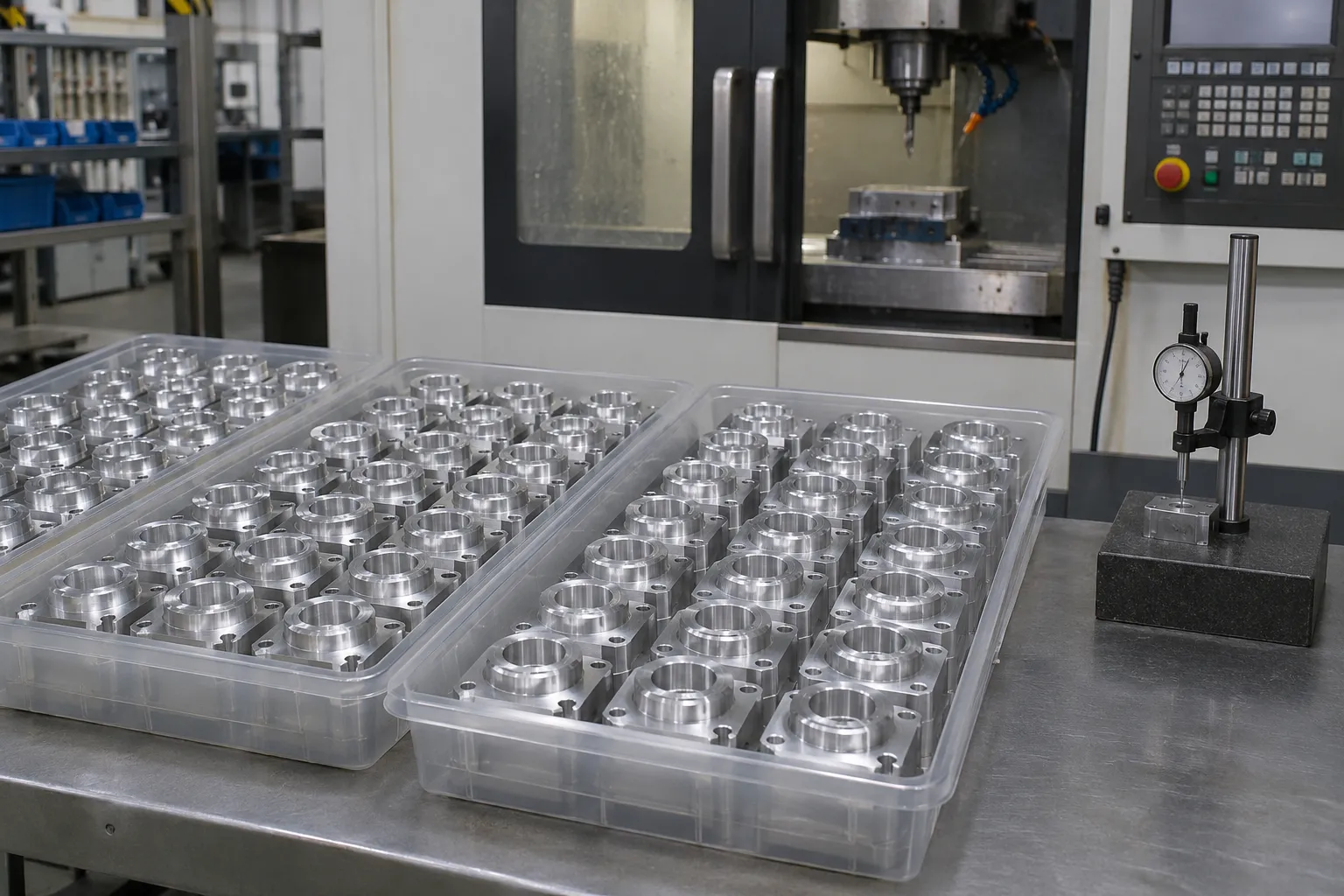
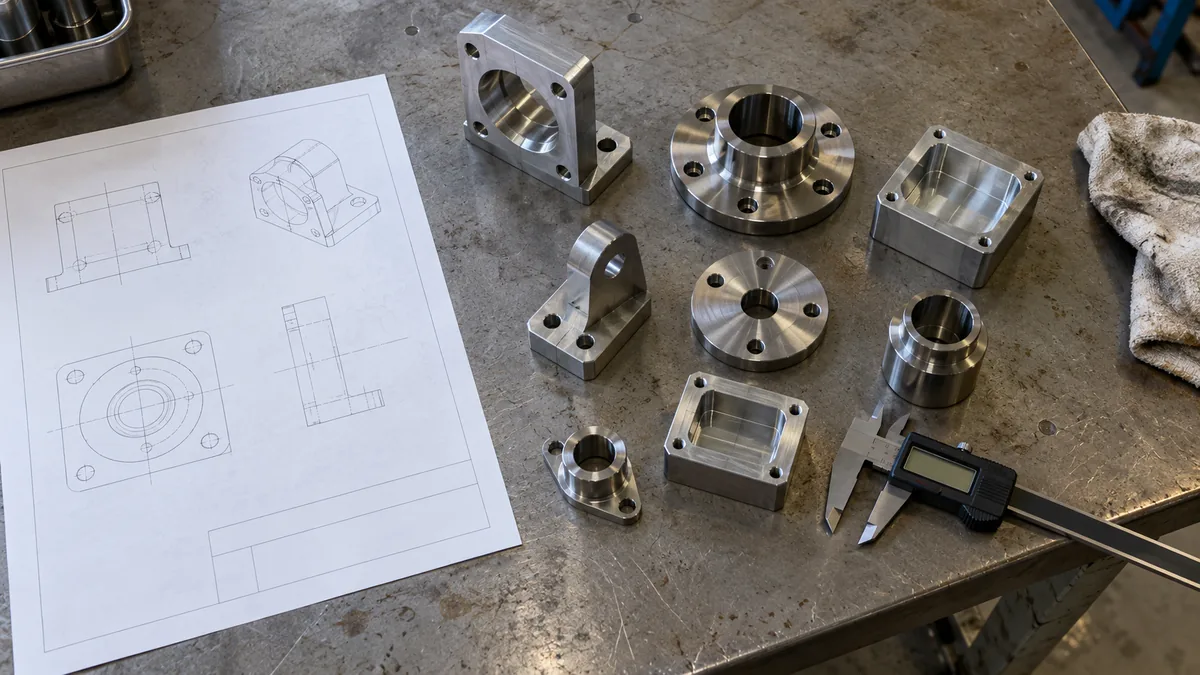
We start with your drawing and a DFM review before any cutting. DFM means design for manufacturability. We then mill or turn your part, with CNC milling up to 3000 mm long and CNC turning up to 400 mm in diameter. Parts are inspected under a quality system certified to ISO 9001.
Our standard tolerance is ±0.05 mm, with ±0.01 mm for precision work and ISO 2768 as the general-tolerance reference. Tolerances depend on your part and are confirmed in DFM review. Standard lead time is 10–15 days, and a mini order can ship in 7 days. Lead time excludes shipping and isn't a guarantee.
Send your drawing with the grade callout for a quote and DFM feedback.
Frequently Asked Questions
What is the main difference between 304 and 316 stainless steel?
Molybdenum. *Machinery's Handbook*, Table 6, lists 316 at 2.0–3.0% molybdenum and 10–14% nickel, with no molybdenum and 8–10.50% nickel in 304. Molybdenum improves resistance to chloride pitting, according to IntechOpen's *Stainless Steels and Alloys*. Nominal annealed strength matches for both grades.
Is 304 or 316 stainless steel magnetic?
Annealed 304 and 316 show almost no magnetic response, according to the *Atlas Technical Handbook*. After substantial cold work, 304 may respond strongly to a magnet while 316 usually stays almost non-responsive. Atlas names wire drawing, rolling, centerless grinding, shot blasting, and heavy polishing as causes, and attributes 316's more stable structure to its higher nickel-to-chromium ratio.
Is 316L different from 316 stainless steel?
Yes. 316L has a lower carbon maximum, 0.03% versus 0.08% for 316, according to *Machinery's Handbook*. MIL-HDBK-5J identifies 316L as the low-carbon modification for welded construction, and *Atlas Grade Datasheets* identifies its resistance to sensitization in welded sections about 5 mm and over. Consider 316L when welding is planned.
What's more expensive, 304 or 316?
316 is more expensive. In the historical price list in *Standard Wrought Austenitic Stainless Steels*, 316 bar ran about 40% above 304 bar. That list is decades old and doesn't establish today's gap, so treat it as direction only. Choose the grade against its service requirements and request a current quote for that callout.
Is 304 or 316 harder to machine?
Published ratings put them level: USAF TO 1-1A-9, Table 2-7, rates both at 40% against B1112 at 100%, described as a starting point. A second source, *Machining the Austenitic Chromium-Nickel Stainless Steels* places 316 in a harder machining group than 304. Neither comparison establishes a cycle-time difference for your specific part.
Which stainless steel is best for machining?
303 machines more readily than 304 and 316. USAF TO 1-1A-9, Table 2-7, rates 303 at 65% against B1112 at 100%, versus 40% for both alternatives. The trade-off: sulfur lowers 303's corrosion resistance below 304's, and MIL-HDBK-5J advises against welding free-machining grades.