
Low-Volume CNC Machining in China for Repeat Small-Batch Production
Our low volume CNC machining China service supports teams that need repeatable small-batch output between prototype and mass release. For typical small batch runs, we align setup strategy, revision control, and inspection so each delivery remains consistent as quantities scale.
- Flexible batch planning for bridge and pilot production runs
- No fixed MOQ constraints for CNC quoting workflows
- Repeatability-focused process control for recurring lots
- Inspection and documentation aligned to incoming QC needs
Low-Volume CNC as the Bridge Between Prototype and Scale
Low-volume machining is the stage where speed still matters but repeatability becomes the main priority. Programs at this stage typically support launch validation, regional rollouts, service parts, or engineering change cycles that are too dynamic for immediate high-volume tooling.
The literature calls this pilot production, and one published case makes the trade explicit: an appliance fluid manifold was zinc die-cast for mass production but machined from solid for its pilot run — a higher cost per piece, accepted because the die could not be justified until the design settled. That is what bridge production buys. You pay more per part on purpose, and what you get for it is the freedom to change the drawing without scrapping tooling.
The defining property of CNC here is the absence of hard tooling: no die, no mould, no pattern to amortise, so a revision costs a program change rather than a new steel tool. What low-volume adds over prototype and first-article builds is tighter revision control, consistent fixtures and stable inspection criteria across batches. If you arrived from our guide to what drives a CNC quote, the breakpoints it promises are set out below.
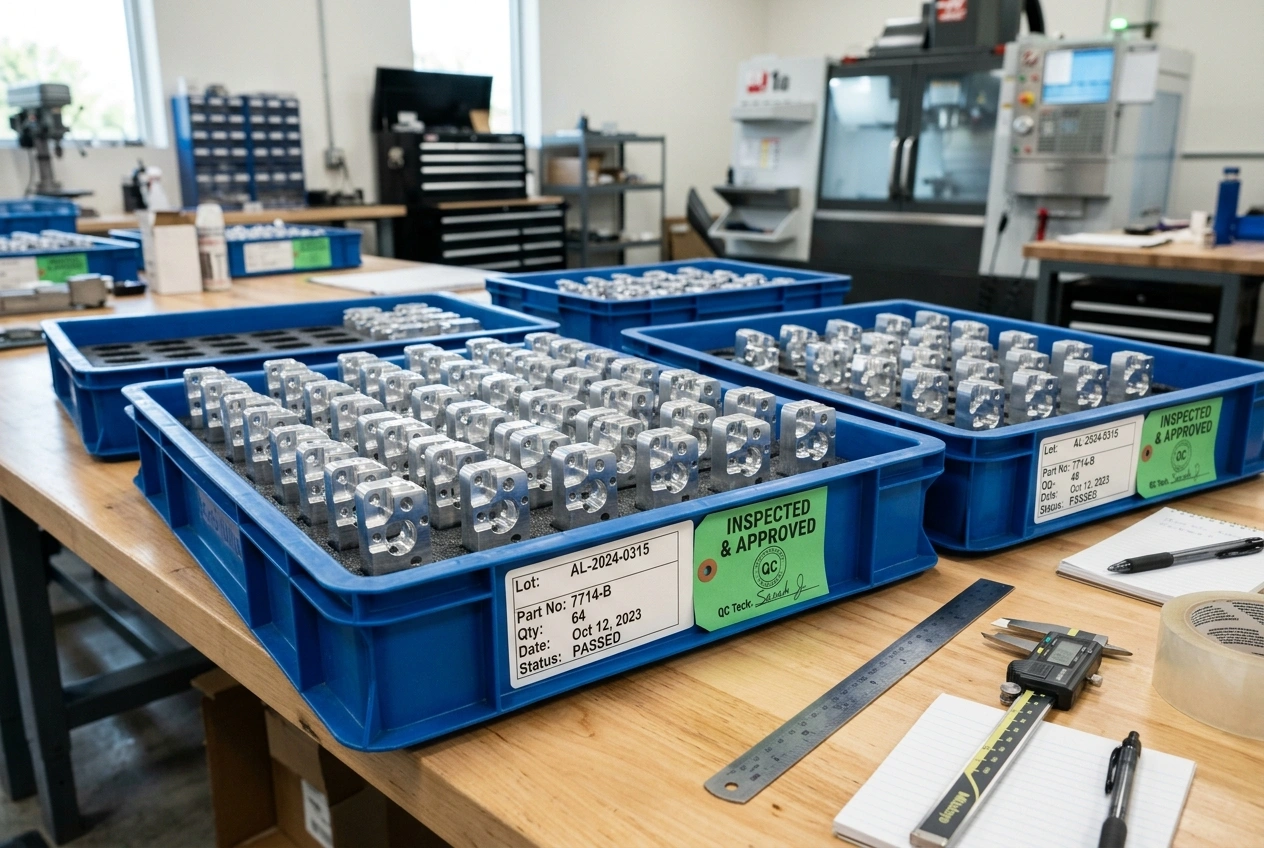
Small Batch Runs with Controlled Process Planning
We support mixed geometry and materials across milling and turning workflows, including complex parts that need multiple operations and repeat quality checks. As lot sizes rise, we optimize setup reuse and fixture strategy to keep part-to-part stability without overengineering for mass production too early.
Related paths include prototyping for faster design iteration and mass production when demand and design maturity justify full-scale release.
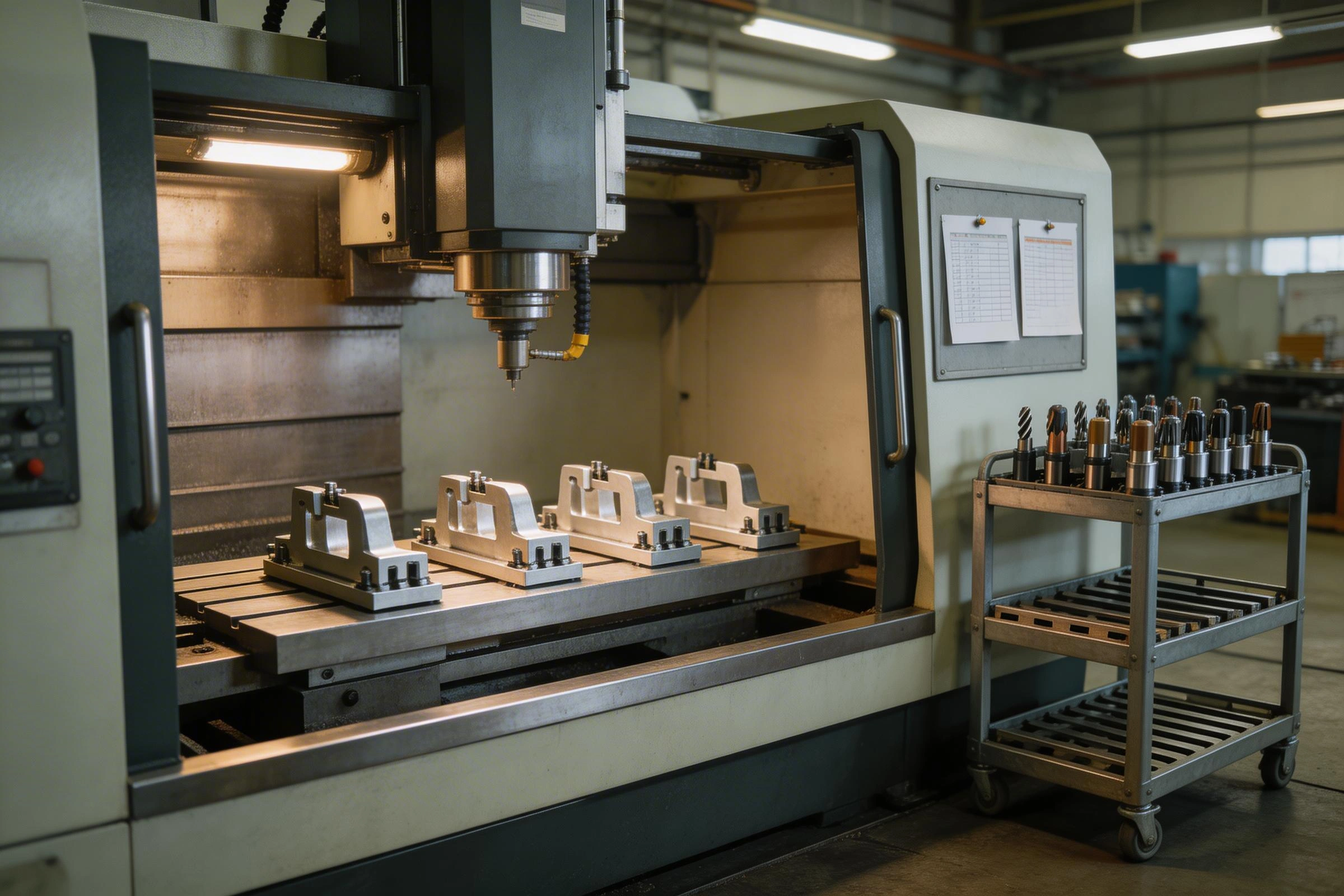
What a Low-Volume Order Typically Looks Like
No fixed MOQ, but planning shifts as quantity climbs. Here is how we commonly approach each band. These are descriptions of how the work gets planned, not quantities you have to hit.
| Batch size | What dominates the cost | Inspection cadence | What we need from you |
|---|---|---|---|
| 1–49 units | Setup and programming, divided across very few parts. The per-cycle handling time does not shrink no matter how few you order | Full first article, then a full dimensional check on the pieces themselves | Model plus a drawing. Expect design changes and say so — at this quantity they cost almost nothing |
| 50–199 units | The fixed setup block starts to disappear into the batch. Fixture strategy begins to pay for itself | First article, in-process checks on critical features, final verification | A design freeze on the toleranced features, and quantity breaks in the RFQ |
| 200–500 units | Cycle time, material and finishing. Setup is now a small share of the total | First and last piece checked completely, with spot checks on critical dimensions in between | A drawing that separates the features carrying function from those that do not |
Those boundaries are not a house rule. A published comparison of three ways to machine the same lot — an ordinary machine with no fixture, an ordinary machine with a jig or fixture, and a special-purpose automatic machine — puts the crossovers at under about 40 pieces, roughly 41 to 199, and above about 200. Our bands sit almost exactly where that arithmetic puts them, which is why we plan the work in these three shapes.
Where the Crossover Sits Between Prototyping, Low-Volume CNC and Hard Tooling
The useful question is rarely can you make it cheaper. It is what does this cost at 50, 250 and 1,000? — and where does the answer change shape?
The published guidelines for when numerical control earns its place read almost like a description of a bridge programme. NC suits parts where:
- Tooling would cost a lot relative to making the part conventionally
- Setup time is long against actual run time
- The work comes in small or variable lots
- Production is intermittent, so storing dedicated tooling between runs is itself a cost
- Repeatability is required part to part and lot to lot
- Design changes are anticipated — editing a program is trivial next to recutting a die
Those criteria are the machining literature's, not ours, and the last one decides most bridge programmes.
| Route | Hard tooling | Standard lead time | Standard / precision tolerance | Where it wins |
|---|---|---|---|---|
| CNC machining | None | 10–15 days; 7 days at the fastest on a mini order | ±0.05 mm / ±0.01 mm | One unit to a few hundred, while the design is still moving |
| 3D printing | None | 2–5 days | ±0.20 mm / ±0.10 mm | Geometry freedom at the very smallest counts |
| Sheet metal fabrication | Low | Prototyping 3–7 days; production 7–15 days | ±0.30 mm / ±0.10 mm | Enclosures, brackets and panels made from flat stock |
| Injection moulding | High | Tooling and samples 25–35 days, then 5–15 days a run | ±0.10–0.20 mm / ±0.05 mm | Polymer parts once the design is frozen and the volume justifies a mould |
| Die casting | High | Tooling and samples 25–35 days, then 7–15 days a run | ±0.30 mm / ±0.10 mm | Metal parts at volume, with threads cast in rather than machined |
Every figure above is Yijin Solution's own published standard for that process. The rows that matter are the tooled ones: a 25 to 35 day wait before the first sample exists, and a design freeze before steel is cut. That wait, not the piece price, is what usually keeps a programme on CNC for its first releases.
| Total production | Machined from bar stock | Made from a forging |
|---|---|---|
| 400 units | $5.36 per part | $8.59 per part |
| 2,000 units | $3.80 per part | $3.46 per part |
| 4,000 units | $3.61 per part | $2.82 per part |
A US Department of Defense producibility handbook's figures, in its own currency and era — published to show the shape of the curve, not as our pricing. At 400 units the tooled route costs about 60 percent more per part and does not overtake the machined one until somewhere between 400 and 2,000. Its own conclusion is the sentence the decision turns on: judge whether total production justifies the extra tooling investment, and weigh the possibility of frequent design changes alongside it.
So: machine while the design is moving and the count is low; tool up when the design is frozen and the volume is real. We quote both ends — this service and high-volume programmes — and we would rather tell you the tooled route has become cheaper than keep quoting the one that has not.
Metals and Plastics for Bridge Production
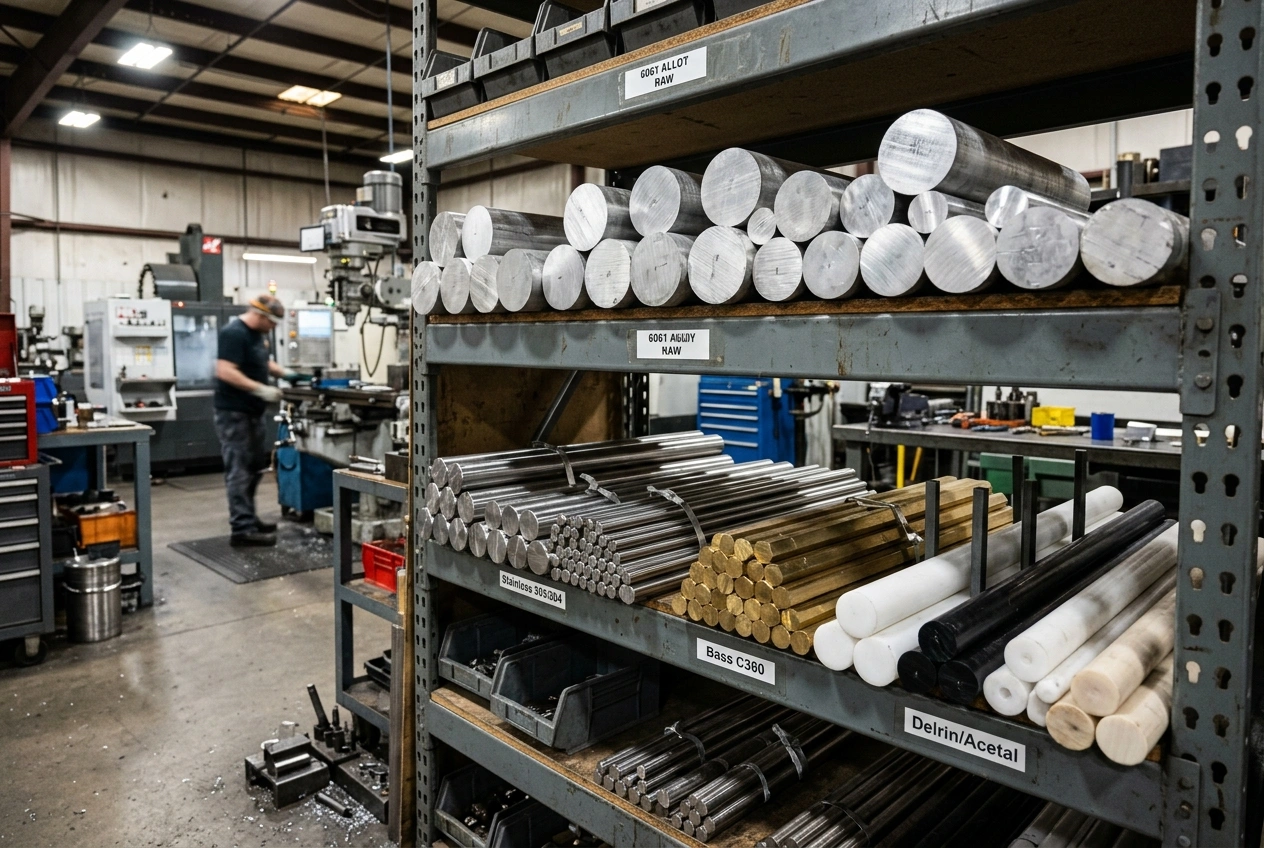
Low-volume programs run in aluminium, stainless, brass, titanium and engineering plastics. What changes at this quantity is why you pick one. Material is among the few costs that scale cleanly with quantity; setup does not. So at 50 pieces the choice is dominated by what is in stock and how fast it cuts, not by price per kilo — a cheaper alloy that machines slowly, or a grade you have to wait for, is the wrong call at 50 and the right one at 5,000.
The same logic favours stock shapes: starting from bar, plate or tube avoids the pattern and mould tooling a cast route needs, and it pays off harder on a short run because setup is a larger share of the cycle. For grade-level behaviour see 6061 and 7075 aluminium, 303, 304 and 316 stainless, C360 free-machining brass, Ti-6Al-4V titanium, and POM, PEEK, nylon and polycarbonate machining.
| Family | Grades we machine | Why it gets chosen at low quantity |
|---|---|---|
| Aluminium | 6061, 7075 | Widely stocked and fast to cut, so a setup-dominated cost stays low. 6061 is the default unless something on the drawing argues otherwise |
| Stainless steel | 303, 304, 316 | 303 when machinability is the constraint; 304 and 316 when the service environment decides and the extra cycle time is accepted |
| Brass | C360 | Free-machining, so turned lots come off quickly — which matters most when the run is short |
| Titanium | Ti-6Al-4V (Grade 5) | A deliberate choice rather than a default. Both cycle time and tooling consumption rise, and at low volume that lands on very few parts |
| Engineering plastics | POM/acetal, PEEK, nylon, polycarbonate, ABS | Where a moulded part is the end goal but the mould is not funded yet — the classic bridge case |
No property figures here on purpose. Naming a grade we machine is a capability statement; a tensile, hardness or machinability number is a measurement, and those belong on the material pages with their own sources.
ISO 9001:2015 Controls for Recurring Batch Consistency
Our quality workflow applies first-article validation, in-process checks on critical dimensions, and final verification tied to your print. For recurring releases we keep the inspection logic consistent so acceptance criteria do not drift from lot to lot.
On a small lot the specific practice matters more than the general promise. Where a part needs 100 percent inspection or carries many measured checkpoints, inspection cost is what explodes — and the published guidance is that the dimensional repeatability of NC usually makes it sufficient to inspect the first and last pieces completely and spot-check the critical dimensions on the rest. That is the cadence we plan to, and repeatability lot to lot is one of the reasons the work runs on NC at all.
The unpopular half is worth saying out loud, because a US defence acceptance standard puts it better than we could: sampling inspection alone does not control or improve quality, which comes from proper product and process design and from process control. A longer report is not a better part.
The quality system is certified to ISO 9001 and ISO 14001, with ISO 13485 and IATF 16949 in place for programmes that need them — which is usually a medical or automotive pilot build. Material certificates and reporting formats are available when specified at order entry.

What We Hold, and What the Drawing Has to Say
Our standard machining tolerance is ±0.05 mm, and we hold ±0.01 mm on features specified as precision. We work to ISO 2768 as the general reference standard.
ISO 2768-1 covers the dimensions that carry no individual tolerance. It sets permissible deviations in four classes — f (fine), m (medium), c (coarse), v (very coarse) — invoked by writing the class in or near the title block, for example ISO 2768-m, and it applies to parts produced by metal removal or formed from sheet metal.
| Nominal length (mm) | f — fine | m — medium | c — coarse | v — very coarse |
|---|---|---|---|---|
| 0.5 up to 3 | ±0.05 | ±0.1 | ±0.2 | — |
| over 3 up to 6 | ±0.05 | ±0.1 | ±0.3 | ±0.5 |
| over 6 up to 30 | ±0.1 | ±0.2 | ±0.5 | ±1.0 |
| over 30 up to 120 | ±0.15 | ±0.3 | ±0.8 | ±1.5 |
| over 120 up to 400 | ±0.2 | ±0.5 | ±1.2 | ±2.5 |
| over 400 up to 1000 | ±0.3 | ±0.8 | ±2.0 | ±4.0 |
| over 1000 up to 2000 | ±0.5 | ±1.2 | ±3.0 | ±6.0 |
| over 2000 up to 4000 | — | ±2.0 | ±4.0 | ±8.0 |
Read the relationship honestly. On a dimension between 30 and 120 mm, class m allows ±0.3 mm — six times looser than our standard machining tolerance. The general class is the fallback for dimensions nobody toleranced. It is not a statement of what the machine can do.
Two things follow. Anything carrying function should be toleranced individually rather than left to the general class — that is what the general class is not for — and since tightening a feature adds finishing passes and inspection, tolerance what matters and leave the rest alone. Under clause 6, a workpiece exceeding a general tolerance does not automatically get rejected provided its ability to function is not impaired.
Our envelope is CNC milling within 3000 mm long and turning within 400 mm diameter. Fewer setups means less stack-up, which is why a part with compound angles is often cheaper to hold to print on single-setup 5-axis work than across three operations. For the longer treatment see what standard and tight tolerances actually cost.
How to Keep Small-Batch CNC Cost Predictable
Setup is a fixed block of cost divided by the batch. That is the whole amortisation argument, and it is easy to overrate. A published worked example puts it plainly: on a stepped shaft with 0.65 hours of setup at a $30 per hour machine rate, setup works out at about $0.016 a part across a batch of 1,250 — while the non-productive time on the same part, 34.9 seconds of loading and tool positioning, costs about $0.29. Eighteen times more.
The difference is that non-productive cost is incurred every time the workpiece is loaded and unloaded, and again for every pass, cut and operation. It is not divided by anything. Small parts feel it hardest, because loading, setting and starting take a finite time however little metal is removed — the real reason small and micro parts do not get proportionally cheaper as they shrink.
So the cost conversation that helps you is about reducing the number of setups, not about the hourly rate. Every face that has to be re-fixtured is another handling cycle and another chance for stack-up. Fixture complexity, tolerance concentration, secondary finishing and inspection depth are the other four drivers, and we scope them explicitly so purchasing sees the same assumptions as production — across milling and turning alike.
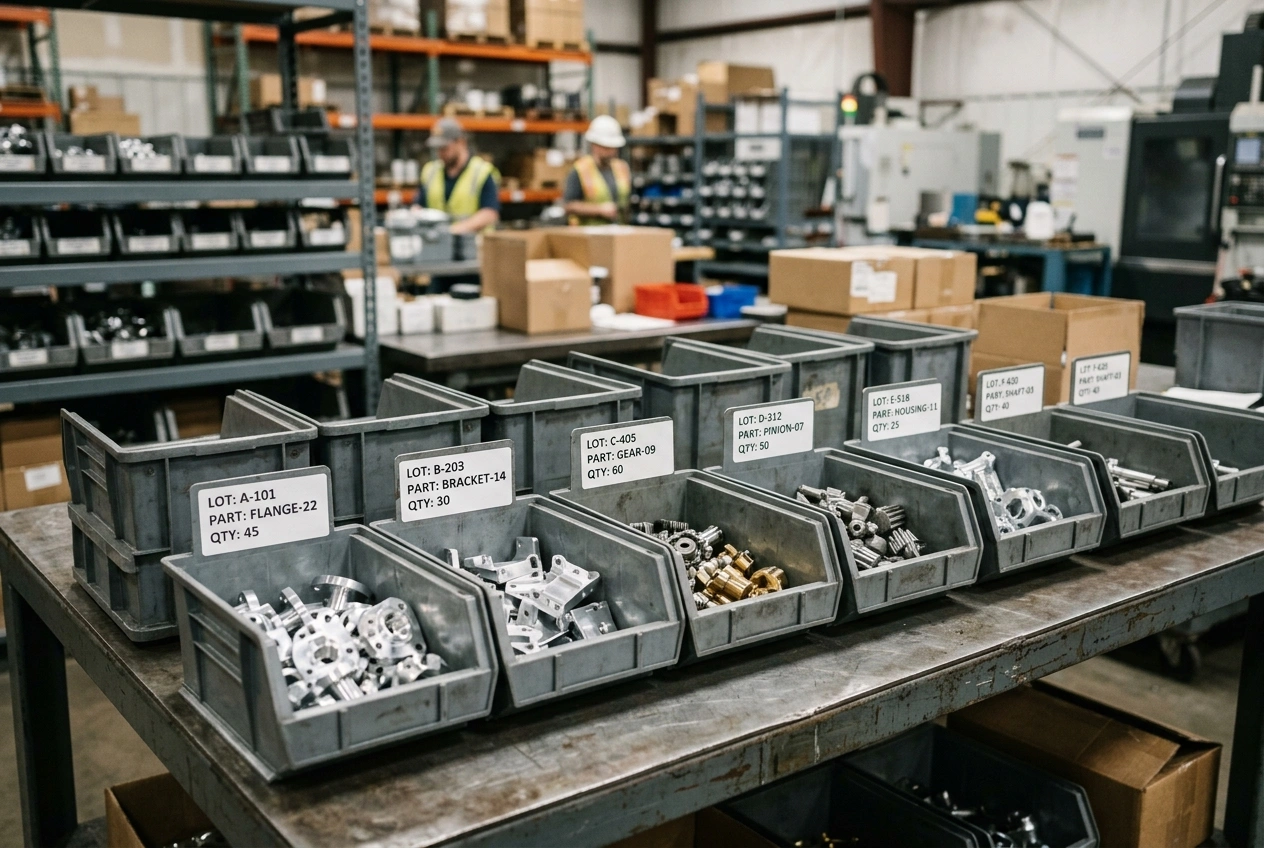
The published savings priority for low-quantity work runs in this order, and it is the reverse of the mass-production order:
- Save tooling cost first — at low volume a higher tooling investment simply cannot be amortised
- Then other overhead
- Then labour
- Materials last
At high volume that order inverts, because spending on tooling and engineering to cut labour and materials becomes justifiable. Knowing which list you are on is most of the quote conversation — and it is why how we keep unit cost down looks different on a 60-piece release than on a 6,000-piece one.
Low-Volume Programs Built for Repeatability
Small batches only work when setup, revision control, and inspection remain stable across deliveries.
Bridge Production Planning
Process choices made for transition from prototype to repeat runs.
Setup Reuse Strategy
Fixture and program continuity to reduce variation across batches.
Inspection-Driven Consistency
Critical dimensions tracked with repeatable checks and clear records.
Export-Ready Delivery
Packing and documentation for North America, Europe, and Australia.
Questions About Low-Volume CNC Machining in China
What is low volume CNC machining and when should I use it?
Low volume CNC machining is small-batch production for teams that are past one-off prototypes but not ready for full high-volume release. It is commonly used for bridge production, pilot launch parts, and controlled market validation where revision speed still matters.
What batch sizes are typical for low-volume CNC runs?
Low-volume lots run from single pieces through repeat releases of a few hundred. What changes across that span is not whether we can run it, but what dominates the cost: setup and programming below roughly fifty pieces, fixture strategy through the middle, cycle time and material above a couple of hundred. We align setup, fixturing and inspection cadence to your release quantity rather than to a fixed band.
Do you have an MOQ for low-volume machining?
No fixed MOQ is required for CNC workflow planning. We can quote from prototype-adjacent quantities through repeat low-volume releases, with economics based on setup intensity, cycle time, material, and quality scope.
How does low-volume machining differ from prototyping?
Prototyping prioritizes design validation and fast iteration. Low-volume production prioritizes repeatability, documented process control, and predictable delivery over multiple batches. The transition usually includes tighter revision control and more structured inspection checkpoints.
What should I upload for a low-volume CNC quote?
Send STEP, STP, IGES, or X_T files plus PDF or DWG drawings for GD&T, threads, and notes not fully captured in the model. Include quantity breaks, material grade, finishing scope, and required documentation so quote and delivery expectations match.
What tolerances can you hold in small-batch production?
Tolerances depend on geometry, material behavior, and setup strategy. For low-volume runs, we focus on critical dimensions and datums with repeatable inspection methods so part-to-part consistency remains stable across batch cycles.
How does lot size affect price and lead time?
Setup is a fixed block of cost divided by the batch, so it falls away quickly as quantity rises, and first-article inspection is fixed per revision rather than per part. What does not shrink is the non-productive time inside every cycle: loading, unloading and repositioning are incurred on each piece and again for every pass. That is why the curve flattens rather than keeps falling. Price and timing also follow material lead time, finishing and inspection depth.
Can low-volume runs scale into mass production later?
Yes. Low-volume programs can serve as a controlled bridge into higher-volume planning by validating process capability, quality criteria, and packaging requirements before large-scale release.
What quality controls are used for low-volume builds?
Our ISO 9001:2015 workflow uses first-article checks, in-process verification on critical features, and final inspection aligned to your drawing. Material certificates and reporting formats are available when specified at order entry.
At what quantity does CNC machining stop being the cheaper option?
There is no single number, but the curve has a published shape. A comparison of three ways to machine one lot puts the crossovers at under about 40 pieces with no dedicated fixture, roughly 41 to 199 for the jig-and-fixture route, and above about 200 before a special-purpose automatic machine pays for itself. Against hard tooling the gap is wider: in one Department of Defense example the same part cost $5.36 machined against $8.59 forged at 400 units, and the forged route did not win until somewhere between 400 and 2,000. Where your line crosses depends on the tooling bill and the labour per piece, and on whether the design is still going to change. Send a drawing with three quantities and we will show you.
What tolerance do you hold on a small production run?
Our standard machining tolerance is plus or minus 0.05 mm, and we hold plus or minus 0.01 mm on features specified as precision. We work to ISO 2768 as the general reference standard, which covers dimensions carrying no individual tolerance in four classes: f fine, m medium, c coarse, v very coarse. Note how loose the general class is: on a dimension between 30 and 120 mm, class m allows plus or minus 0.3 mm, six times looser than our standard. It is a fallback for untoleranced dimensions, not a statement of capability. Name the class in the title block and tolerance the functional features individually.
How does inspection work on a fifty-piece lot - do you check every part?
Not usually, and the published guidance explains why. Where a part needs 100 percent checking, inspection is what makes a small lot expensive, and the dimensional repeatability of NC generally makes it sufficient to inspect the first and last pieces completely and spot-check critical dimensions on the pieces between. That is the cadence we plan to at this quantity. Worth being honest about what inspection does, too: sampling alone does not control or improve quality, which comes from process design and process control. We are certified to ISO 9001 and ISO 14001, with ISO 13485 and IATF 16949 for programmes that need them.
Will the second order be cheaper than the first?
Usually yes, and for a reason we can point at rather than a discount. Unit cost falls with cumulative quantity by an experience factor: steep curves sit near 75 percent per doubling, a complex low-volume product is more like 90 percent, and a genuine one-off can be 100 percent, meaning no improvement at all, because it does not live long enough for the repeatable parts of the process to pay back. So the answer depends on whether the part comes back with the same drawing, material and fixture. Where it does, the saving comes from workholding, and the break-even on any fixture is its cost divided by the saving per part.
What do you need in the RFQ to quote a low-volume run accurately?
Five things beyond the model. Quantity breaks, because the routing that is cheapest at 40 pieces is rarely cheapest at 400. The general tolerance class in the title block, plus individual tolerances on the features that carry function, so we are not pricing precision onto dimensions that do not need it. The material grade rather than the family, since stock availability drives lead time at small quantities. Finishing and documentation scope at order entry rather than after the first article. And whether the design is frozen, because that answer decides whether the machined or the tooled route is the right recommendation.
Request a quote for low-volume CNC production
Upload CAD and drawings for small-batch runs. We return lead time, process assumptions, and inspection scope in writing.
Why buyers choose us
- 12–24h quote turnaroundPricing, lead time, and DFM feedback — fast.
- NDA-ready & confidentialYour CAD files and IP stay protected.
- ISO 9001:2015 certifiedDocumented inspection at every stage.
- No fixed MOQFrom single prototypes to full production runs.