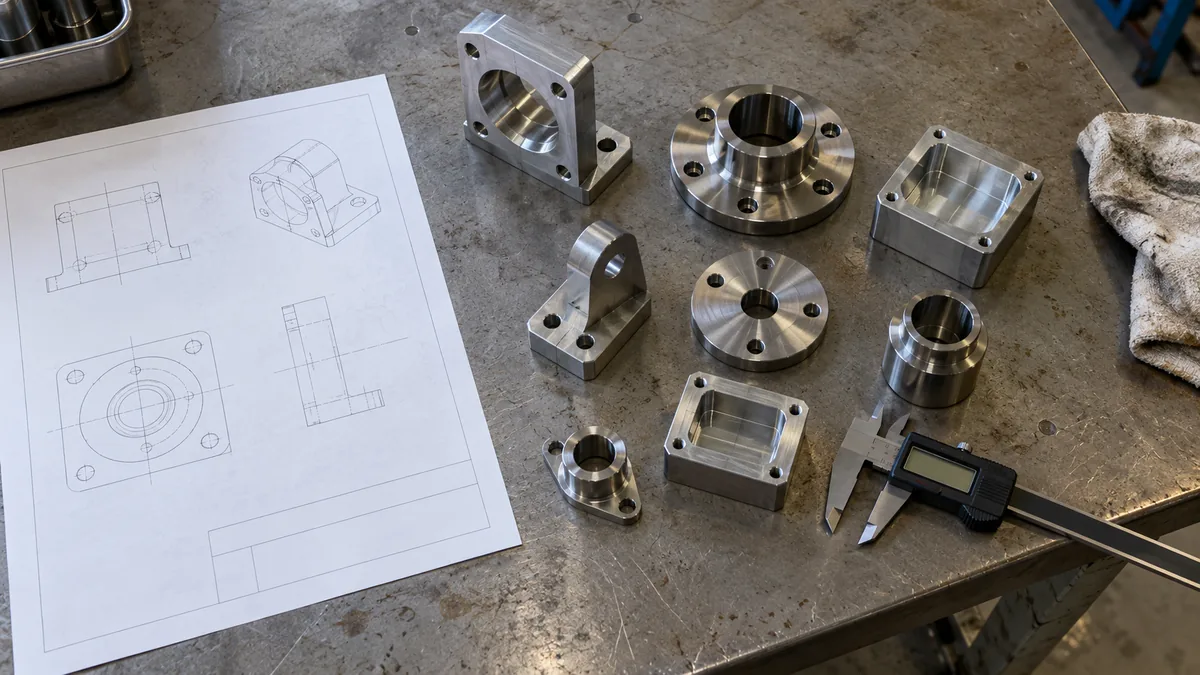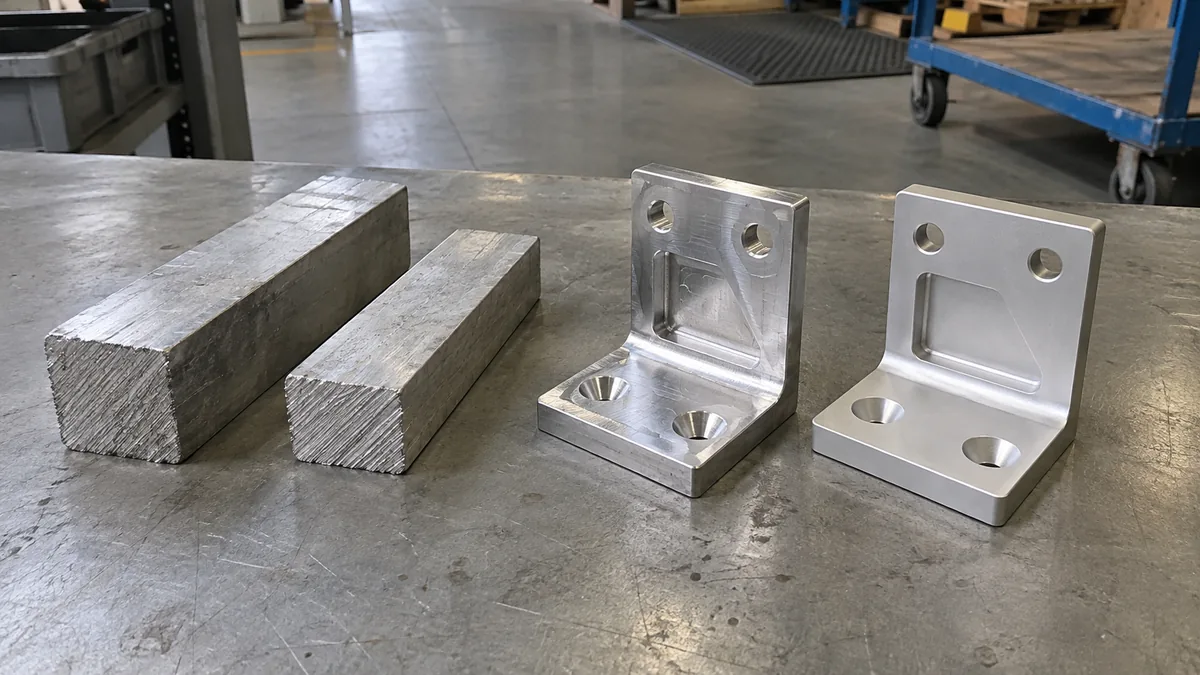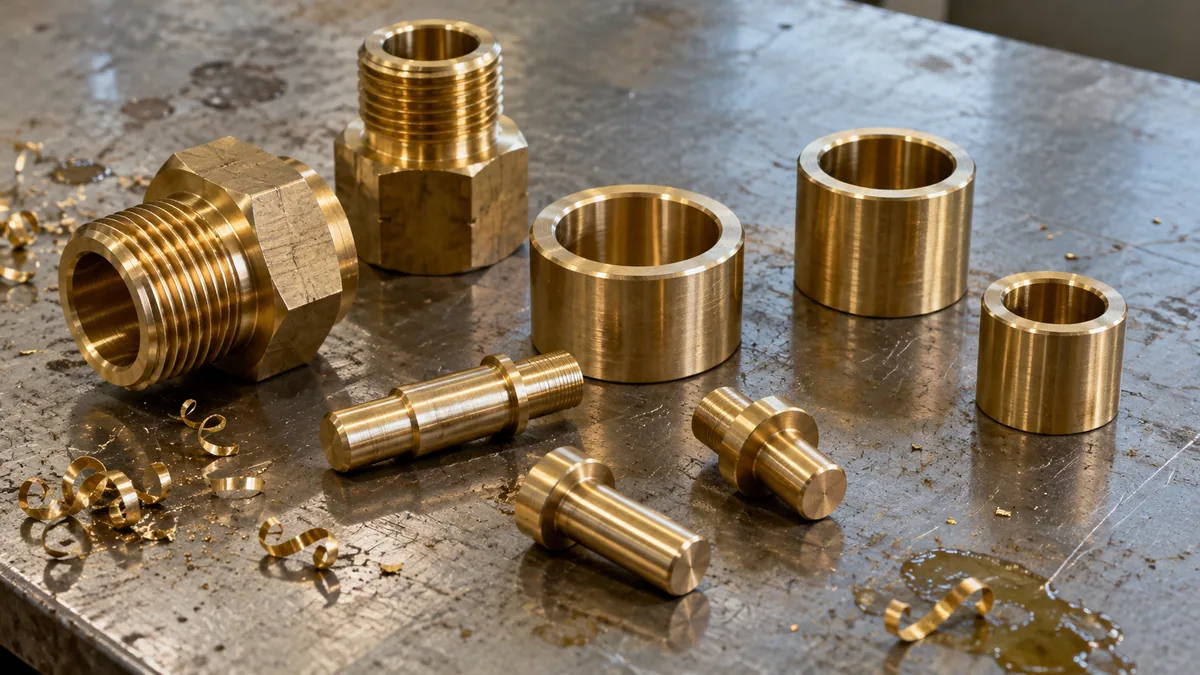
Two shops can quote the same part at very different prices without either being wrong — they are making different assumptions about batch size, tolerance and finish. This guide breaks a CNC quote into the parts it is actually built from, explains honestly why China-based pricing is lower, and lists the changes that reduce cost without touching quality. It covers what it costs to have a part made, not what it costs to buy a machine. If you are still shortlisting, our comparison of China CNC machining suppliers sets out what each one publishes.
What a CNC Quote Is Actually Made Of
Standard cost models for machined parts build the price from three components: material cost per part, machine time × machine hourly rate (the rate itself covering machine amortisation and operator cost), and tooling cost, with setup amortised across the batch.
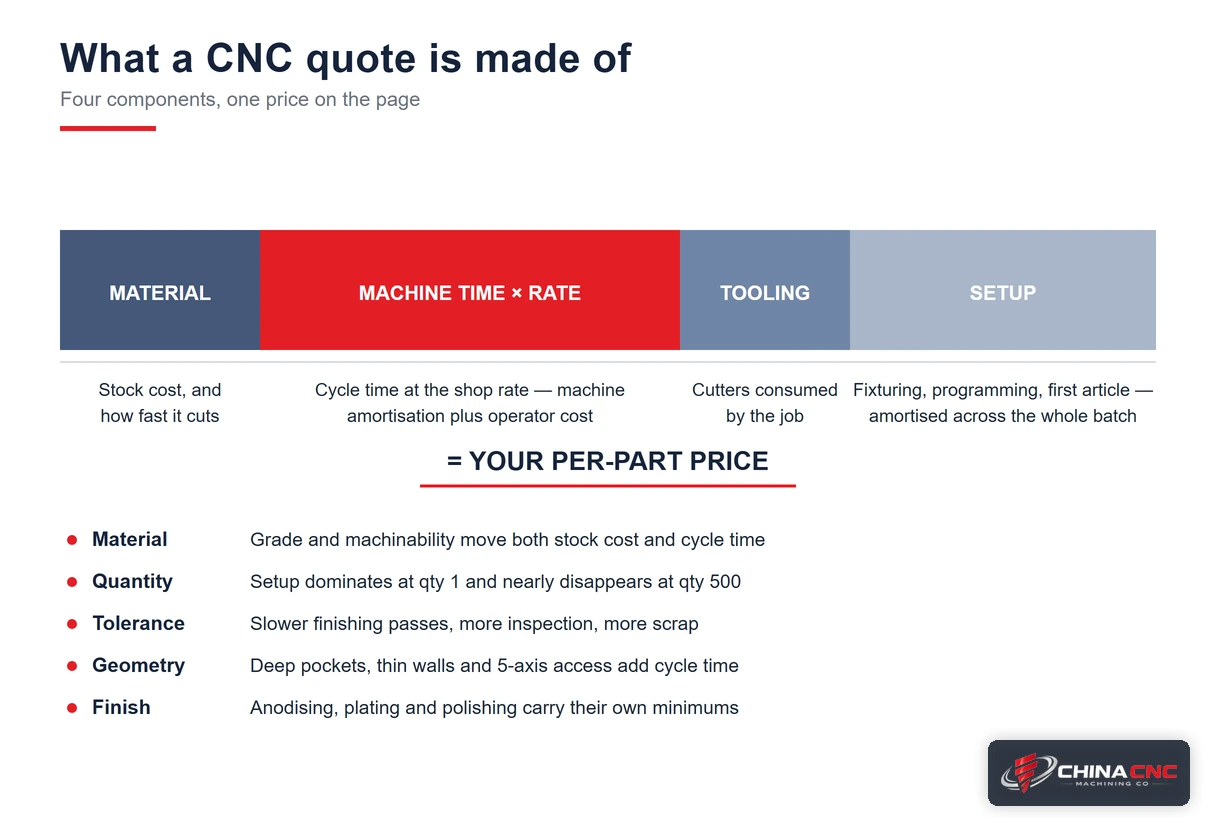
That structure explains nearly every quote surprise:
| Driver | Effect on your price |
|---|---|
| Material | Both the stock cost and how fast it cuts. Free-machining brass and 6061 cut quickly; stainless, titanium and Inconel cut slowly and wear tooling faster. |
| Quantity | Setup is a fixed cost spread across the batch. It dominates the per-part price at qty 1 and nearly disappears at qty 500. |
| Tolerance | Tighter tolerances mean slower finishing passes, more inspection, and more scrap. |
| Geometry | Deep pockets, thin walls and features needing 5-axis access add cycle time and fixturing. |
| Surface finish | Anodising, plating and polishing are separate operations with their own minimums. |
Why Quantity Moves the Price More Than Anything Else
Setup — fixturing, work-holding, programming, first-article inspection — is paid once per batch. At quantity 1 you carry all of it. At quantity 500 you carry 1/500th of it.
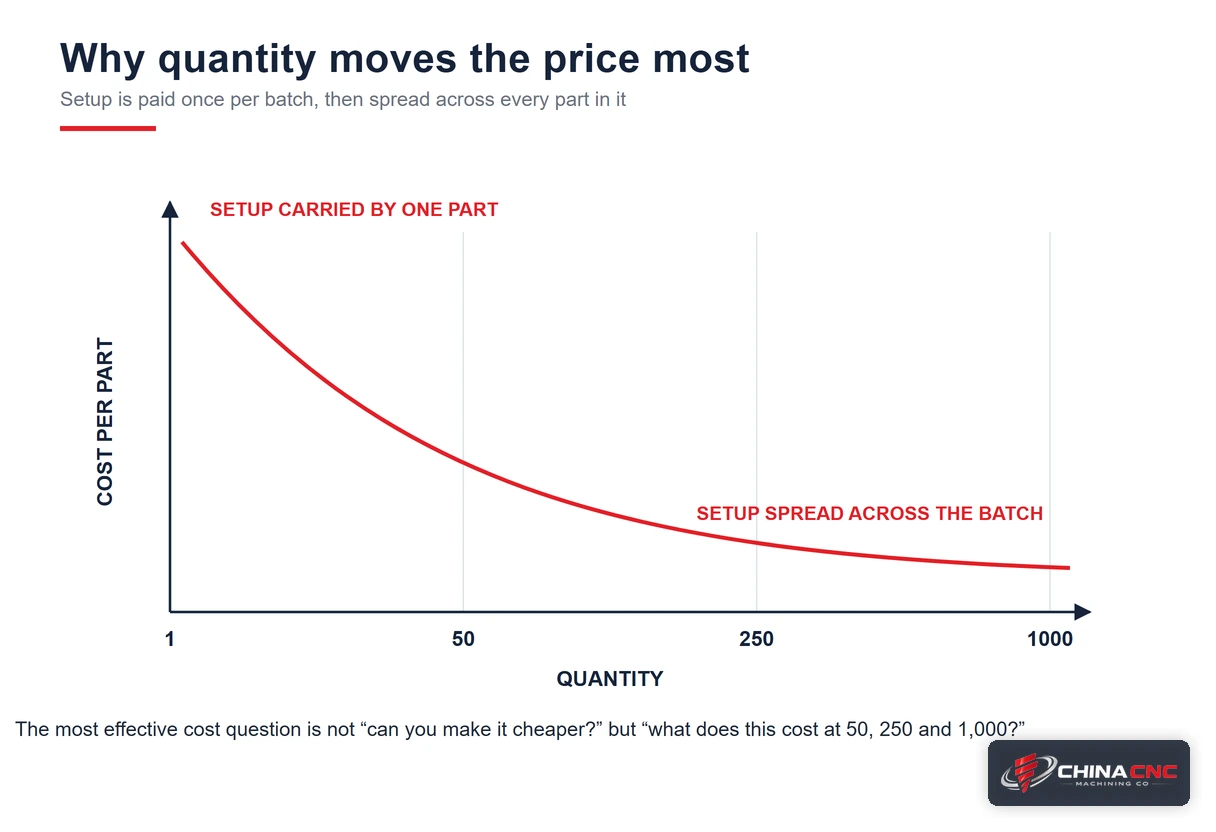
This is why “the same part” can quote at wildly different per-part prices, and why the single most effective cost question is usually not “can you make it cheaper?” but “what does this cost at 50, 250 and 1,000?” See low-volume and mass production for where the breakpoints sit.
Why Is CNC Machining Cheaper in China?
Worth answering plainly rather than defensively, because buyers ask it directly.
- Labour and overhead rates are lower, and the machine hourly rate in every cost model bundles operator cost with machine amortisation — so a lower labour rate moves the whole per-hour figure.
- Machine utilisation is higher. Amortisation is spread across more running hours, which lowers the effective hourly rate.
- The material and finishing supply chain is dense. Stock, tooling, heat treatment, anodising and plating are all locally available, which cuts both cost and lead time between operations.
- Scale. Shops running continuous production absorb fixed costs across far more parts.
What it should not mean is lower quality — that is a function of process control and inspection, not geography. Ask any supplier for their certifications and their inspection process. Ours are ISO 9001:2015, ISO 13485 and IATF 16949. See our affordable machining services for how we hold that cost structure without moving on inspection.
What You Can Change to Cut Cost Without Cutting Quality
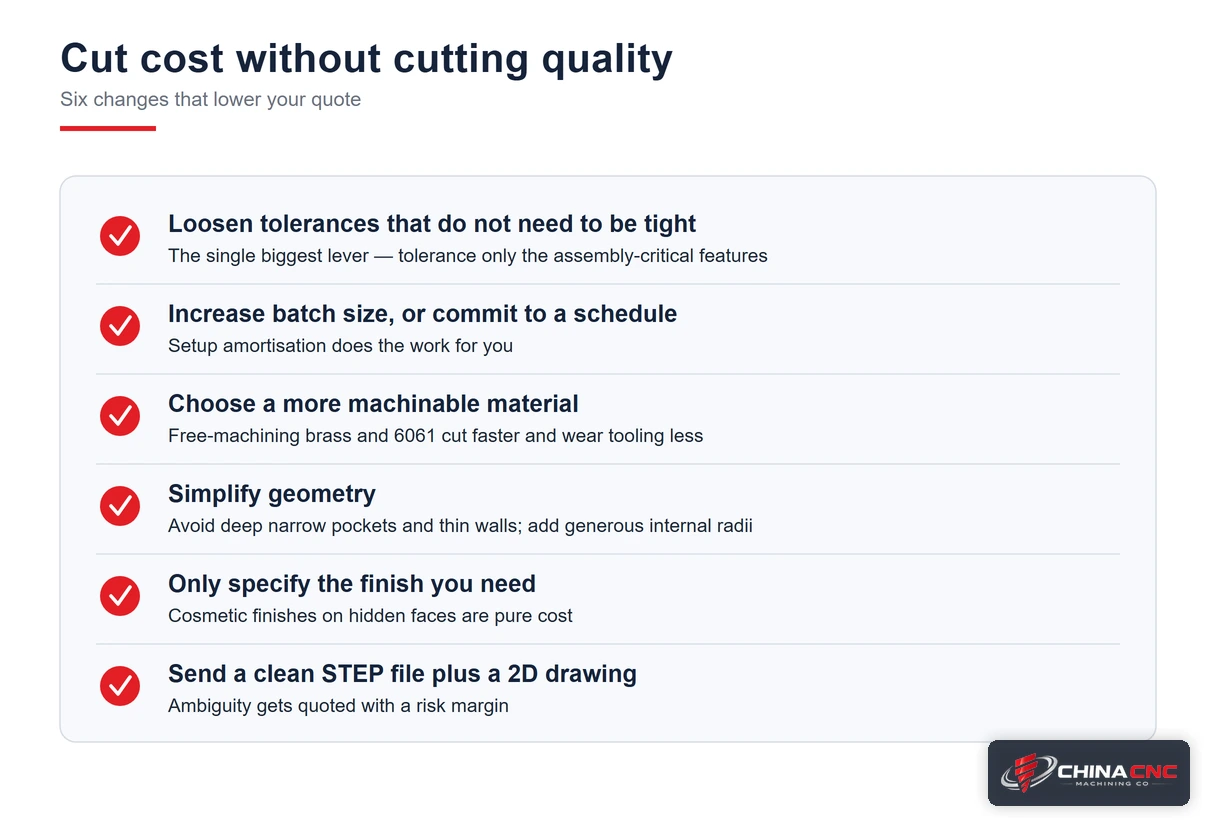
- Loosen tolerances that do not need to be tight. The single biggest lever. Tolerance assembly-critical features; let the rest run to the general class.
- Increase batch size, or commit to a schedule. Setup amortisation does the work.
- Choose a more machinable material where the application allows it.
- Simplify geometry. Avoid deep narrow pockets and very thin walls; add generous internal radii so a larger, faster cutter can be used.
- Only specify the finish you need. Cosmetic finishes on internal or hidden faces are pure cost.
- Send a clean STEP file plus a 2D drawing. Ambiguity gets quoted with a risk margin.
What We Need to Quote Accurately
A 3D file (STEP preferred), a 2D drawing for any toleranced or GD&T features, material and grade, quantity, surface finish, and your target delivery date. Samples are often ready in 3–5 days, and production programs typically fall in the 2–3 week range after order confirmation, with the exact date confirmed during quoting rather than promised after the PO.
Get your real quote in minutes — upload your CAD file and we will come back with pricing and a manufacturability check.
Frequently Asked Questions
How much does CNC machining cost?
There is no flat rate — a quote is built from material cost, machine time at an hourly rate, tooling, and setup spread across the batch. The same part can differ several-fold per unit between quantity 1 and quantity 500. Upload your file for real pricing rather than working from an average.
How much does CNC machining cost per hour?
Shop hourly rates bundle machine amortisation with operator cost, so they vary with machine type and region — a 3-axis mill and a 5-axis machine are not the same rate. In practice the hourly figure matters less than total cycle time, which your part geometry and tolerances determine.
How much does it cost to get a part CNC machined?
It depends on material, quantity, tolerance, geometry and finish. The fastest way to a real number is a STEP file plus a 2D drawing with your tolerances marked.
How to calculate CNC machining cost?
Material cost per part, plus machine time multiplied by the shop's hourly rate, plus tooling, plus setup divided across the batch. Setup amortisation is what makes larger batches cheaper per part.
How to estimate CNC machining cost?
For a rough estimate, start from the stock size needed, estimate cycle time from feature count and tolerance, and add setup divided by your quantity. For anything you will actually buy, a real quote is faster and more accurate.
Why is CNC machining so cheap in China?
Lower labour and overhead rates, higher machine utilisation spreading amortisation further, a dense local supply chain for material and finishing, and production scale. It reflects cost structure, not lower quality standards — quality comes from process control and inspection, so ask any supplier about their certifications and inspection process.
What is the cheapest metal to CNC?
Free-machining materials such as brass and aluminium alloys like 6061 are usually cheapest — not only lower stock cost but faster cutting and less tool wear, which reduces machine time. Stainless, titanium and nickel alloys cost more on both counts.