Brass shows up on almost every OEM bill of materials that includes fittings, connectors, inserts or turned hardware. Leaded brass is several times more machinable than carbon steel and takes rolled threads and knurls cleanly. Those advantages depend on choosing the right grade, though.
Brass CNC machining is the cutting of copper-zinc alloys on CNC lathes and mills to a drawing. This guide explains why free-cutting brass machines so well and how the common grades compare. It also covers tool setup, corrosion and the drawing details that keep turned brass parts cost-effective. For the grades we stock and machine, see our brass CNC machining page.
Why Does Brass Machine Faster Than Most Metals?
Brass machines fast because the right grades break chips into small fragments and run with low cutting forces. That lets a lathe run at high spindle speeds without tangled chips or rapid tool wear. The best-known example is C36000 free-cutting brass.
Why does lead make C36000 the machinability benchmark?
C36000 has a nominal composition of 61.5% copper, 35.4% zinc and 3.1% lead, according to Machinery's Handbook. MIL-HDBK-698A rates it 100 on the copper-alloy machinability scale, and every other copper alloy is scored against it.
The lead does the work. It doesn't dissolve in brass, so it collects at the grain boundaries. A 2023 study in Metals explains the effect. Lead "will significantly reduce shear strength, resulting in very good chip breaking." It melts at 327.5 °C, so during cutting a thin, semi-liquid film forms at the tool. That film lowers friction, cutting forces and tool wear.
How do brass chips behave compared with steel?
Free-cutting brass produces small, fragmented chips that clear the cut easily. Unleaded brasses such as 70/30 cartridge brass behave differently. They form long, tough chips and cause higher tool wear, according to the Copper Development Association's machining guide.
The difference shows up in cycle time. In one Copper Development Association application study, switching a knob insert from 12L14 free-machining steel to C36000 cut cycle time by 32%. Most of the gain came from faster tapping, and the thread finish improved too. High-speed tests in the same CDA series ran leaded brass above 3,000 surface feet per minute for over four hours with minimal tool wear.
Which Brass Grade Should You Specify for a CNC Part?
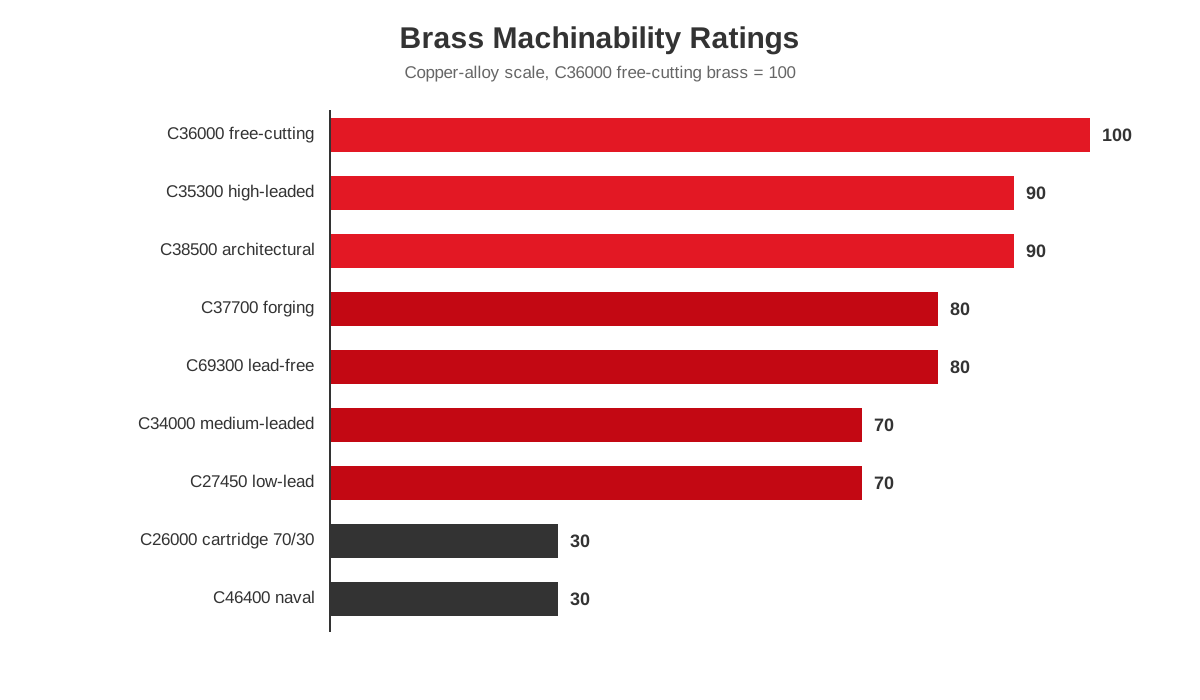
Specify the grade by what the part has to do after machining. Free-cutting grades win on cycle time. Unleaded grades win on formability, and lead-free grades cover drinking water and lead-restricted products. The table compares common grades on the copper-alloy machinability scale, where C36000 equals 100.
| Grade, UNS | Common name | Machinability rating | Where it fits |
|---|---|---|---|
| C36000 | Free-cutting brass | 100 | Turned parts with rolled threads or knurls |
| C35300 | High-leaded brass | 90 | Turned and milled parts |
| C38500 | Architectural bronze, a leaded brass | 90 | Extruded shapes and machined profiles |
| C37700 | Forging brass | 80 | Hot-forged parts finished by machining |
| C69300 | Lead-free brass | 80 | Lead-restricted and drinking-water parts |
| C34000 | Medium-leaded brass | 70 | Machined parts with rolled threads or knurls |
| C27450 | Low-lead yellow brass | 70 | Lead-restricted parts with moderate machining |
| C26000 | Cartridge brass, 70/30 | 30 | Deep-drawn and formed parts |
| C46400 | Naval brass | 30 | Marine hardware, valve stems, nuts and bolts |
Ratings for C36000, C35300, C38500, C37700, C34000, C26000 and C46400 come from MIL-HDBK-698A and Machinery's Handbook. Ratings for C69300 and C27450 come from the Copper Development Association's lead-free rod guide.
C36000 free-cutting brass for turned parts
C36000 is the correct specification for most turned brass parts. The Design for Manufacturability Handbook notes that it meets about 90% of applications where brass is called for. Machinery's Handbook lists it as suited to machining, roll threading and knurling. Its strength range across tempers runs 49–68 ksi tensile and 18–45 ksi yield.
C26000 cartridge brass when the part is formed
C26000 is 70% copper and 30% zinc, with no lead. It's rated 30 for machinability, but it has excellent cold-working properties. The Design for Manufacturability Handbook lists deep-drawn and spun parts and eyelets as typical uses. Choose it when the part is drawn, bent or swaged after machining. Expect slower cycle times and longer chips than with C36000.
Lead-free brass for drinking water and restricted parts
Lead-free brasses replace lead with other chip-breaking elements. Bismuth "operates similarly to the Pb addition," according to published research on advanced alloys. In the US, the Reduction of Lead in Drinking Water Act has limited plumbing products to 0.25% lead since January 4, 2014. That figure is a weighted average over the wetted surface area. Products that contact drinking water are also tested to NSF/ANSI 61. Lead-free C69300 rates 80 on the machinability scale, so lead-free parts don't have to give up much cycle time.
How Should You Call a Brass Grade on an RFQ to a China Shop?
Give the UNS number, the temper and any lead limit that applies. A grade number alone leaves too much room for substitution. The extra detail costs nothing and makes every quote comparable.
Write the UNS number and its EN equivalent
Use the UNS number, such as C36000, as the primary callout. European drawings often use EN designations instead. The Copper Development Association's machining guide treats CuZn36Pb3, or CW603N, as equivalent to C36000. CuZn39Pb3, or CW614N, is the standard European free-machining brass. A Chinese mill certificate may list a national standard grade name. Ask for the chemical composition on the certificate, so your quality team can match it to the drawing.
State the lead limit when the part touches water or is lead-restricted
If the part goes into drinking-water service or a lead-restricted product, state the requirement on the drawing. Name the alloy, such as C69300, and the standard it must meet. Don't rely on a note such as "lead-free brass" alone.
How Do Machinists Set Up Tools for Brass?
Brass needs a different tool geometry from steel. Soft brass tends to pull a sharp, high-rake tool into the cut. A US Army machine tool manual notes that "soft materials, like brass and bronze, also use a reduced rake angle to prevent the drill from grabbing." The US Navy's machinery repairman manual describes grinding the drill's cutting lip flat. That gives "the scraping action needed for brass rather than the cutting action used for steel."
Speed is the other big difference. The Copper Development Association's machining guide lists carbide finishing speeds of 150–450 m/min for free-cutting brasses. For unleaded 70/30-type brasses, the range drops to 90–240 m/min. Cutting fluid is recommended for all thread chasing. These are the details our CNC turning service sets in the program before the first part is cut.
Which Design Details Keep Turned Brass Parts Cost-Effective?
Most of the cost in a turned brass part is cycle time, and the drawing controls much of it. A few choices keep cycle time low without changing how the part works.
- Specify C36000 unless the part needs forming or a lead limit. Moving to a lower-rated grade slows every operation on the part.
- Let threads and knurls be rolled where the design allows. Machinery's Handbook lists C36000 as suited to roll threading and knurling. Our CNC threading guide compares tapping, thread milling and single-point threading.
- Call out the temper as well as the alloy. Half-hard C36000 has strength comparable to hot-rolled 12L14 steel, according to a Copper Development Association study.
- Use standard tolerances where function allows. We hold ±0.05 mm as standard and ±0.01 mm on precision features, with ISO 2768 as the general reference. Tight tolerances only where needed keep inspection time down.
What Corrosion Risks Should You Plan For in Brass Parts?
Two corrosion failure modes affect brass, and both grow with zinc content. Both can be managed at the material stage.
What is dezincification?
Dezincification is corrosion that removes zinc from the alloy and leaves a porous, brittle copper matrix behind. Copper Development Association marine guidance notes that brasses above about 15% zinc are susceptible. Small arsenic additions of 0.02–0.06% inhibit it in alpha brasses. For water fittings, dezincification-resistant grades such as CW602N were developed to resist it while still machining well.
What causes stress corrosion cracking in brass?
Stress corrosion cracking needs two things at once: tensile stress and a trigger such as ammonia. It was historically called "season cracking." MIL-HDBK-729 notes that "the sensitivity of brasses to stress-corrosion cracking increases with the amount of zinc present in the alloy." A stress-relief anneal at 280–300 °C after cold working can prevent it, according to Copper Development Association guidance. If a part will be press-fitted or crimped and used near ammonia, ask for stress relief on the drawing. Plating and other finishes are covered on our surface finishing page.
How Do We Run a Brass Turned-Part Project?
Every brass project starts with your drawing and the grade callout. Our engineers review the design for manufacturability, confirm the alloy and temper, and flag any feature that adds cycle time. We then turn and mill the parts in our Shenzhen factory, under a quality system certified to ISO 9001.
We turn parts up to 400 mm in diameter. Standard lead time is 10–15 days, and a mini order can ship in 7 days.
Frequently Asked Questions
Why is brass used in CNC machining?
Brass is used in CNC machining because free-cutting grades break chips into small fragments and run at high cutting speeds with low tool wear. C36000 is the 100 baseline on the copper-alloy machinability scale. It also takes rolled threads and knurls cleanly.
What is brass machining?
Brass machining is the removal of material from brass bar or plate by turning, milling, drilling and threading to make parts to a drawing. Round parts are turned on CNC lathes from rod, and milling adds flats, slots and cross holes.
What are uses for brass machining parts?
Machined brass parts include water fittings, threaded inserts, valve stems, nuts, bolts and marine hardware. Leaded grades suit high-volume turned parts. Lead-free grades cover parts that contact drinking water.
Can brass chip during machining?
Yes, and in free-cutting brass that's the goal. Leaded grades such as C36000 break into small chips that clear easily. Unleaded grades such as 70/30 cartridge brass form long, tough chips, so they machine more slowly and wear tools faster.
How is brass turned in metalworking?
Brass is turned on a lathe with a low or zero rake tool, so the cutter scrapes rather than digs in. Free-cutting grades run at high surface speeds, and published high-speed tests used a water-soluble emulsion coolant. Threads and knurls can be cut or rolled in the same setup.