Most drawings say “M6 tapped hole” and stop there. But a shop has at least three different ways to cut that thread, and the one it picks changes the price, the lead time, and whether the thread is even possible in your material. Commercial screw threads run from 0.3 mm diameter at 360 threads per inch in watch work up to 600 mm pipe at roughly two threads per inch — so “threaded hole” covers an enormous range. This guide covers how threads get machined, when each method is used, and what to put on the drawing so it quotes right the first time.
The Three Ways a CNC Shop Cuts a Thread
| Method | How it works | Best for | Watch out for |
|---|---|---|---|
| Tapping | A tap is driven into a pre-drilled hole; the thread pitch pulls the tool in | Standard sizes, high volume, softer materials | One tap per size and pitch; tap breakage in deep or hard holes; limited chip room |
| Thread milling | A rotating cutter helically interpolates around the hole under CNC control | Blind holes, hard or gummy materials, large diameters, non-standard threads | Needs a machine capable of helical interpolation; slower per hole at high volume |
| Single-point turning | A pointed lathe tool makes repeated passes, each deeper, along the thread helix | External threads on turned parts, coarse pitches, very large diameters | One of the more demanding CNC lathe operations |
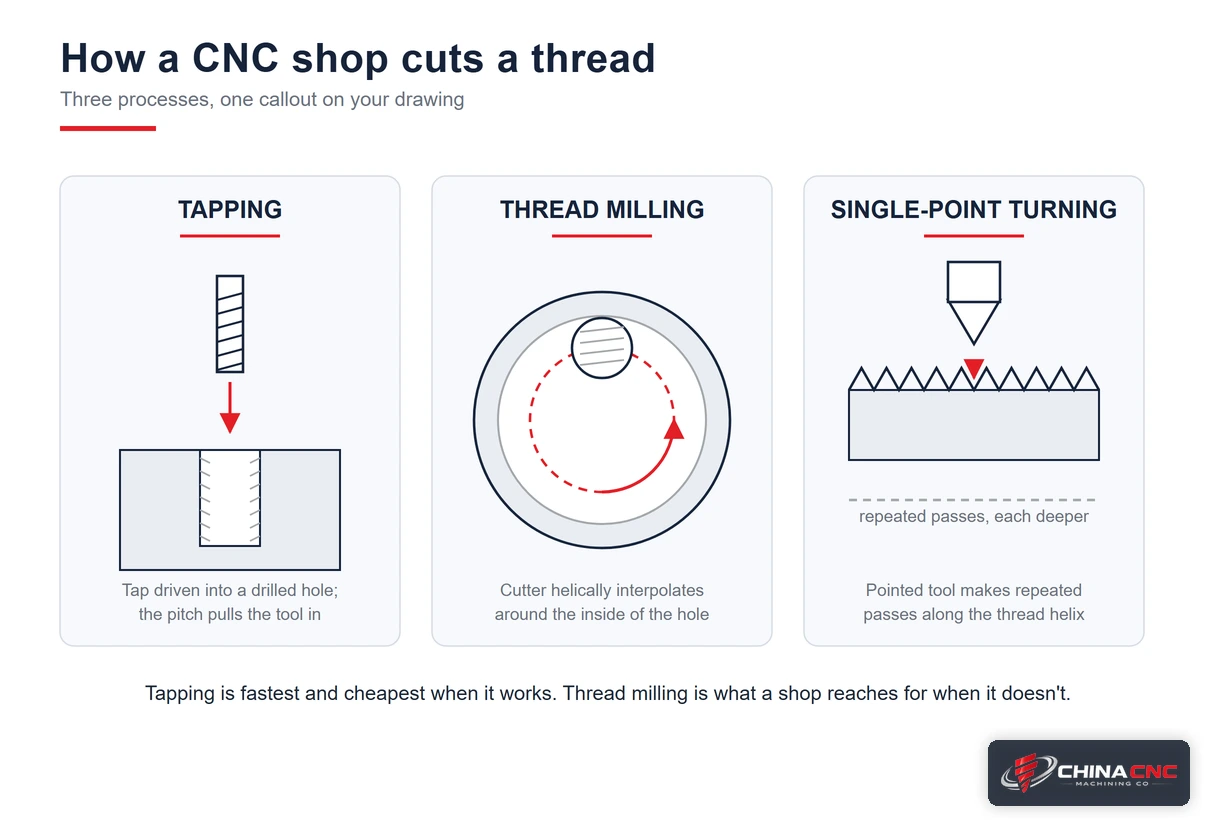
The short version for a buyer: tapping is fastest and cheapest when it works; thread milling is what a shop reaches for when it doesn't. There are many cases where tapping or single-point threading is impractical, difficult or outright impossible, and thread milling is what overcomes them.
When Thread Milling Beats Tapping
There are four classic reasons a milled thread may be preferred over a tap or die:
- The pitch is too coarse to cut with a die.
- Milling is more efficient than a single-point tool in a lathe for that thread.
- A smoother, more accurate thread is needed than a tap or die will give.
- The thread sits so close to a shoulder or other surface that milling is the only practical way to reach it.
There are practical machining reasons behind those. In thread milling the cutter runs at higher speed and lower feed than tapping or thread turning, and critically the feed is not tied to the thread pitch — so surface finish can be dialled in independently. Chips are much smaller with more room to clear, the power required drops considerably, thread engagement approaching 100% becomes achievable, and tapered threads can be generated on the same machine. On diameter, virtually any thread size can be milled, and with high concentricity.
What this means for your quote: if your part has a blind hole, a hard material like stainless or titanium, a large thread, or a thread crowded against a shoulder, expect the shop to thread mill it. That is usually the right call — it is not upselling.
UNC vs UNF — Which Series Should You Specify?
Both are Unified inch threads at the same nominal diameter. The difference is pitch:
| UNC (coarse) | UNF (fine) | |
|---|---|---|
| Threads per inch | Fewer | More |
| Assembly speed | Faster, fewer turns | Slower |
| Tolerance of damage and dirt | Better — coarse threads survive knocks | Worse — fine threads gall and cross-thread more easily |
| Holding power in thin walls | Lower | Higher — more threads engaged per unit depth |
| Vibration resistance | Slightly lower | Slightly higher |
| Tapping in soft material | Preferred | Risk of stripping |
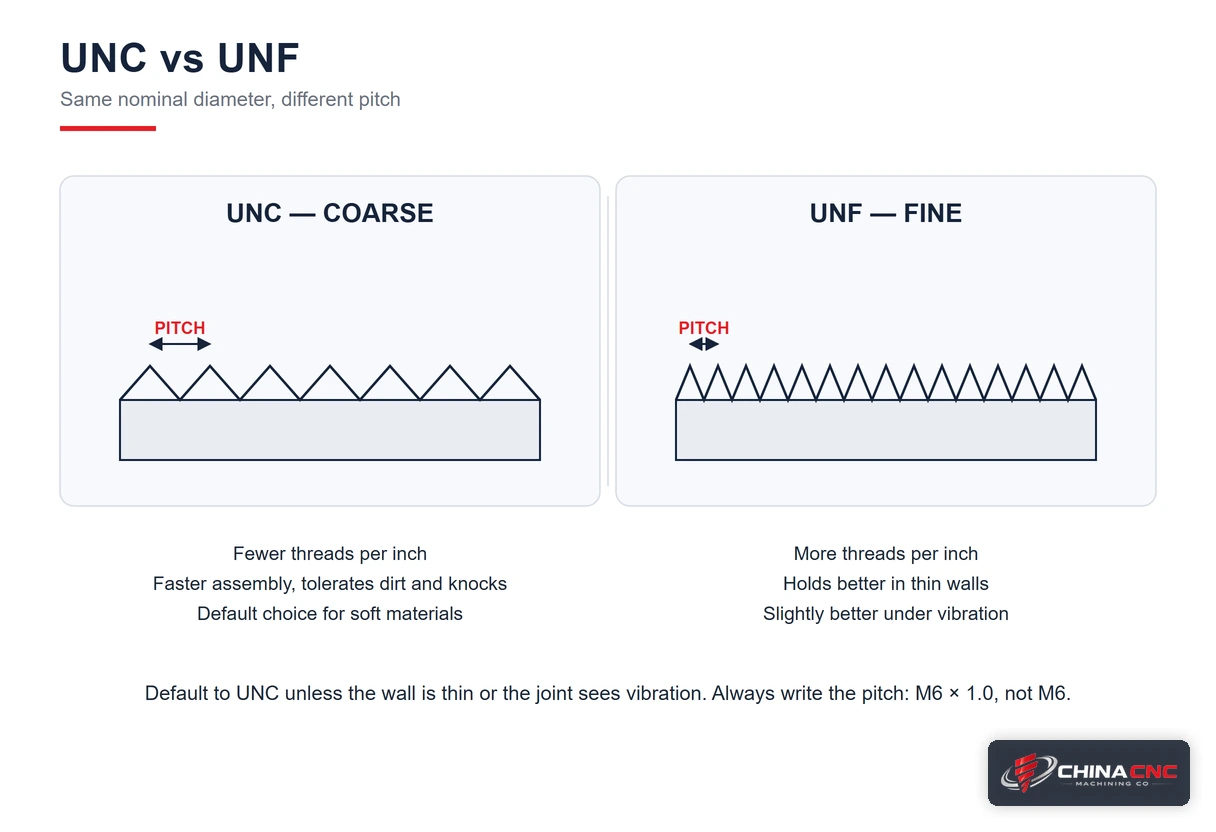
Default to UNC unless you have a specific reason not to. Reach for UNF when the wall is thin, when you need finer adjustment, or when the joint sees vibration. Reach for UNC when the material is soft (aluminium, brass, plastics), when parts are assembled by hand in the field, or when threads may be exposed to dirt.
The same logic applies to metric: M6 × 1.0 is the coarse default, M6 × 0.75 the fine option — and they are different threads. Writing M6 alone implies coarse. Always write the pitch when the thread is fine; a dropped pitch is one of the most common causes of a re-quote.
Class of Fit — and Why 2A/2B Is Almost Always Right
Classes 1, 2 and 3 run loosest to tightest. Federal thread standards direct that a class 2A external thread paired with a class 2B internal thread should be considered first, because that pair is designed for general use.
One detail worth knowing: an allowance — a deliberate clearance — is applied only to the 1A, 1AR and 2A external classes. Internal threads get no such clearance, which is part of why the 2A/2B pairing assembles as easily as it does. Class 3 exists for high-stress or safety-critical joints and costs more to hold and to gauge. Class 1 is for fast assembly where threads may be dirty or bruised.
Rule of thumb for buyers: if you have not thought hard about the fit, specify 2A/2B. Specifying 3B “to be safe” adds cost without adding function on most parts.
Thread Depth, Blind Holes, and the 75% Rule
A tap cannot cut cleanly to the bottom of a blind hole. Two consequences for your drawing:
- Call out full-thread depth and total hole depth separately. They are different numbers, and the difference is real material and real machine time.
- Leave relief below the thread for chips and for the tap's lead.
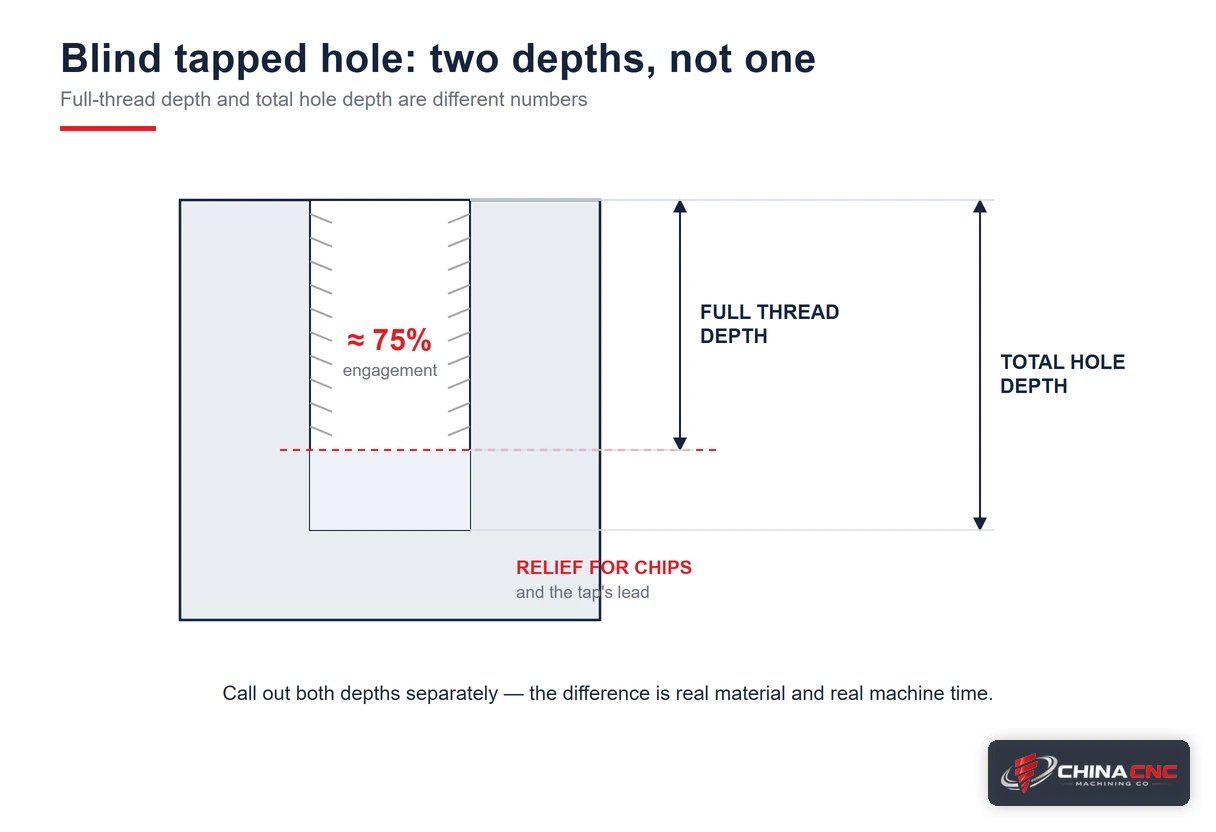
Thread engagement is specified as a percentage of full thread, and standard practice targets around 75% for most work — that captures the large majority of the joint's strength while keeping tapping torque and tap breakage manageable. Pushing toward 100% sharply increases torque and breakage risk for very little added strength — one of the reasons a shop may quote thread milling instead, since it reaches high engagement without the torque penalty.
One shop-floor detail that explains a cost difference you may see: when thread milling a blind hole it is preferable to start at the bottom and work outward, so the tool avoids recutting chips trapped at the base of the hole.
Common Thread Sizes and Tap Drill Reference
Values below are nominal for roughly 75% thread engagement.
Unified inch — coarse (UNC) and fine (UNF)
| Size | UNC (TPI) | Tap drill | UNF (TPI) | Tap drill |
|---|---|---|---|---|
| #6 | 32 | #36 (0.1065") | 40 | #33 (0.113") |
| #8 | 32 | #29 (0.136") | 36 | #29 (0.136") |
| #10 | 24 | #25 (0.1495") | 32 | #21 (0.159") |
| 1/4" | 20 | #7 (0.201") | 28 | #3 (0.213") |
| 5/16" | 18 | F (0.257") | 24 | I (0.272") |
| 3/8" | 16 | 5/16" (0.3125") | 24 | Q (0.332") |
| 1/2" | 13 | 27/64" (0.4219") | 20 | 29/64" (0.4531") |
ISO metric — coarse
| Thread | Pitch (mm) | Tap drill (mm) |
|---|---|---|
| M3 | 0.5 | 2.5 |
| M4 | 0.7 | 3.3 |
| M5 | 0.8 | 4.2 |
| M6 | 1.0 | 5.0 |
| M8 | 1.25 | 6.8 |
| M10 | 1.5 | 8.5 |
| M12 | 1.75 | 10.2 |
What to Put on Your Drawing So It Quotes Correctly
- Thread designation in full, including pitch (M6 × 1.0, not M6)
- Class of fit (2B, 6H) — or state “general purpose” and let the shop apply 2B
- Full-thread depth and total hole depth, called out separately
- Whether the thread is blind or through
- Any thread-locking, plating or coating — plating changes the effective thread size, so it must be known before the tap or cutter is chosen
- If the thread is critical, say so — that tells the shop to thread mill rather than tap
You do not need to specify the method. Telling a shop “tap this” when the feature really wants thread milling just removes an option that would have made your part cheaper or better. Specify the thread and its requirements; let the process follow. Our CNC milling and CNC turning teams review every thread callout during quoting.
Send your drawing with the thread callouts marked and we will confirm every one before quoting — get a quote on your threaded part.
Frequently Asked Questions
What is CNC threading?
Cutting a screw thread on a CNC machine rather than by hand or with a manual die. The three common methods are tapping (driving a tap into a drilled hole), thread milling (helically interpolating a rotating cutter around the hole), and single-point turning (repeated passes with a pointed tool on a lathe).
What is the difference between tapping and thread milling?
A tap cuts the whole thread form in one pass and its feed is locked to the thread pitch — one tap per size and pitch. A thread mill interpolates around the hole, so its feed is independent of pitch, chips are smaller with more room to clear, power draw is lower, and one cutter can produce several diameters. Tapping is faster and cheaper where it works; thread milling handles blind holes, hard materials, large diameters and threads close to a shoulder.
What is the difference between UNC and UNF threads?
Both are Unified inch threads of the same nominal diameter. UNC has fewer threads per inch (coarse), UNF more (fine). Coarse assembles faster and tolerates damage and contamination better; fine holds better in thin walls and resists vibration loosening slightly better. Default to UNC unless the wall is thin or the joint sees vibration.
How deep should a tapped hole be?
Call out full-thread depth and total hole depth as separate numbers, and leave relief below the last full thread for chips and the tap's lead. Most work targets around 75% thread engagement, which holds nearly all of the joint's strength without the tapping torque and breakage risk of chasing 100%.
How do you specify a thread on a drawing?
Give the full designation including pitch (M6 × 1.0 or 1/4-20 UNC), the class of fit (2B or 6H), full-thread depth and hole depth separately, whether it is blind or through, and any plating or thread-locking — plating changes the effective thread size.