Most machined aluminum parts start as one of two alloys: 6061 or 7075. Both cut cleanly on a CNC mill, both anodize, and both are standard in bar and plate. The difference shows up after machining. 7075-T6 carries well over 1.5 times the strength of 6061-T6, but it gives up weldability and some corrosion resistance to get there.
This guide compares the two alloys on the properties that change a design decision. It covers strength, machining, welding, stress corrosion and anodizing. It closes with how to call each grade on an RFQ, so the quote comes back on the right stock. For the grades we machine most often, see our aluminum CNC machining page.
What Is the Difference Between 6061 and 7075 Aluminum?
6061 is a magnesium-silicon alloy, and 7075 is a zinc alloy with magnesium and copper. That chemistry decides everything else. Nominal 6061 carries about 1.0% magnesium and 0.6% silicon. Nominal 7075 carries about 5.6% zinc, 2.5% magnesium and 1.6% copper, according to Machinery's Handbook.
The table compares typical values in the T6 temper.
| Property, typical | 6061-T6 / T651 | 7075-T6 / T651 |
|---|---|---|
| Alloy family | 6000 series, Mg-Si | 7000 series, Zn-Mg-Cu |
| Ultimate tensile strength | 45 ksi, about 310 MPa | 83 ksi, about 572 MPa |
| Yield strength | 40 ksi, about 276 MPa | 73 ksi, about 503 MPa |
| Elongation, 1/16 in. sheet | 12% | 11% |
| Brinell hardness | 95 | 150 |
| Shear strength | 30 ksi | 48 ksi |
| Fatigue endurance limit | 14 ksi | 23 ksi |
| Modulus of elasticity | 10.0 × 10⁶ psi | 10.4 × 10⁶ psi |
| Density | 0.098 lb/in³, 2.71 g/cm³ | 0.101 lb/in³, 2.80 g/cm³ |
| Thermal conductivity | 104 Btu/hr·ft·°F | 70 Btu/hr·ft·°F |
| Arc and gas weldability | Weldable by all common methods | No common method developed |
| Stress corrosion resistance, T6 | High across 6000 series tempers | Low in the short-transverse direction |
Strength and hardness figures come from Machinery's Handbook, 31st edition. Weldability and stress corrosion ratings come from MIL-HDBK-694A and MIL-STD-1568E.
How Much Stronger Is 7075-T6 Than 6061-T6?
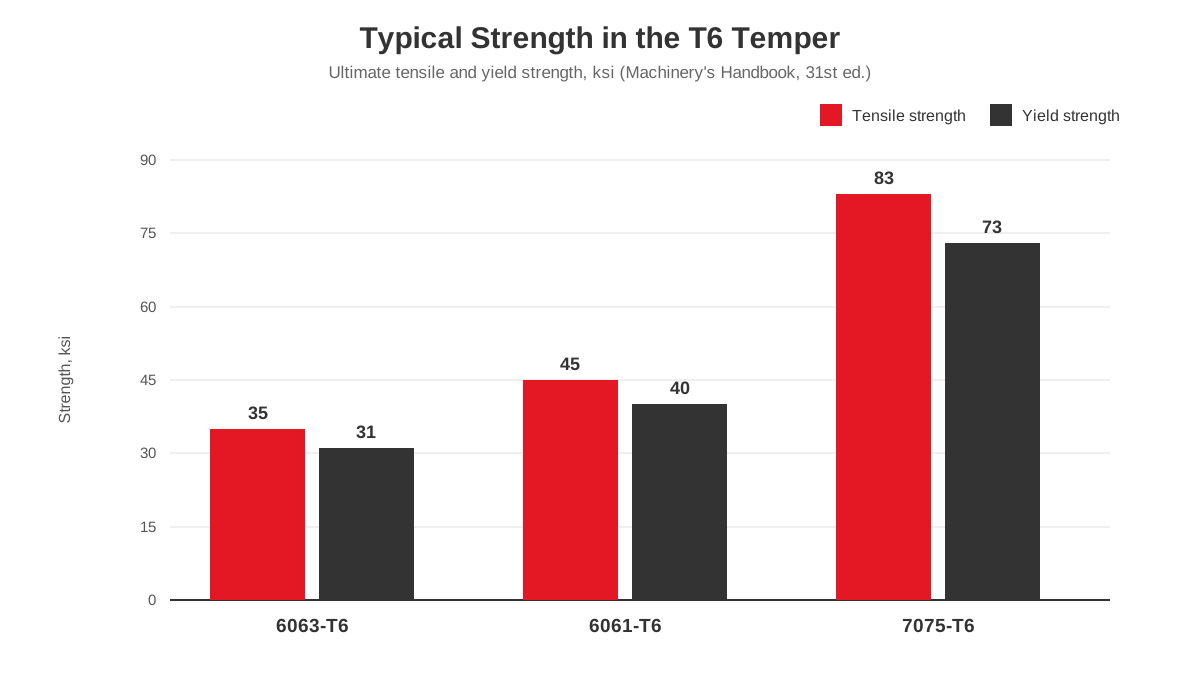
7075-T6 has a typical yield strength of 73 ksi against 40 ksi for 6061-T6. That's about 1.8 times higher. Tensile strength rises from 45 to 83 ksi, and the fatigue endurance limit rises from 14 to 23 ksi. Hardness climbs from 95 to 150 Brinell, which helps on wear surfaces and threaded features.
Those gains let a 7075 part carry the same load with a thinner wall or a smaller section. That weight saving is what you're paying for when you specify 7075.
Why does stiffness stay almost the same when strength nearly doubles?
Stiffness depends on the modulus of elasticity, and that barely changes between the two alloys. 6061 sits at 10.0 million psi and 7075 at 10.4 million psi. A 7075 bracket with the same geometry deflects almost as much as a 6061 one under the same load. It just survives a far higher load before it yields. If your design is limited by deflection rather than strength, switching alloys won't solve it. A deeper section or a rib will.
Which Alloy Machines Better on a CNC Mill or Lathe?
Both alloys machine fast and cleanly in the T6 temper. MIL-HDBK-694A notes that soft, gummy aluminum tempers give long, stringy chips, while harder alloys and tempers machine better. For machining, that puts the T6 temper well ahead of the annealed O temper.
At low cutting speeds, many aluminum alloys build up material on the cutting edge, which spoils the finish. Higher speeds avoid most of it. Drilling studies published in Aluminium Alloys, Theory and Applications found chip length falls as cutting speed rises for both 6061-T6 and 7075-T6. Short, broken chips are what you want for unattended production.
In practice, both alloys suit the same equipment and the same tolerance bands. Our CNC milling service holds ±0.05 mm as standard on either alloy, and ±0.01 mm on precision features. The alloy choice should come from what the part has to do, not from the machine.
How Do Welding and Stress Corrosion Change the Choice?
Welding and stress corrosion are where 7075 gives ground. Both points come from the same chemistry that makes it strong, so they're worth settling before you lock the design.
Why is 6061 the alloy for welded assemblies?
6061 is rated weldable by gas, arc and resistance methods in MIL-HDBK-694A. 7075 is rated D for gas and arc welding, meaning no common method has been developed. The Design for Manufacturability Handbook puts it plainly: 6061 is readily weldable, and welding 7075 isn't recommended. Even on 6061, the heat-affected zone loses strength, because the heat coarsens the precipitates that harden the T6 temper. If a 7075 part needs joining, it's fastened or machined from solid instead.
What does the T73 temper fix in 7075?
T73 is an overaged temper that trades some strength for much better stress corrosion resistance. MIL-STD-1568E rates 7075-T6 low for short-transverse stress corrosion resistance, and 7075-T73 very high. The trade-off is strength. Aluminum Design Manual minimums for extruded 7075-T73 bar run about 70 ksi tensile and 61 ksi yield. The equivalent 7075-T6 minimums are about 81 and 73 ksi. If a 7075 part will sit under sustained tension in a humid or salty environment, ask your engineer whether T73 or T7351 is the correct specification.
Does 7075 Anodize as Well as 6061?
Both alloys anodize, but 6061 gives the more predictable result. Anodizing references describe 6000 series alloys as having an excellent response to anodizing. Alloying elements change how the coating builds, and hard anodizing shows the difference most.
Sheasby and Pinner's finishing reference shows how far the colors drift in hard anodizing. 6061 coatings start tan or gray and darken toward black at about 75 µm. 7075 coatings turn black at about 25 µm, then lighten toward blue-gray as they thicken. If cosmetic color matters on a 7075 part, approve a sample before production.
Dimensions change too. MIL-HDBK-132A notes that the dimensional buildup is about half the anodic coating thickness, so all machining should be finished before anodizing. Our surface finishing service covers anodizing after machining. State the coating type and thickness on the drawing, so the allowance is planned before cutting.
When Should You Upgrade From 6061 to 7075?
6061-T6 remains the default for most machined aluminum parts. It welds, anodizes evenly, resists general corrosion well and conducts heat better. The upgrade earns its place when strength is the limiting factor.
Consider 7075 when the part:
- carries a high static or fatigue load and needs a thinner or lighter section
- has wear surfaces or fine threads that benefit from 150 Brinell hardness
- will be fastened or machined from solid, never welded
- won't sit under sustained tension in a corrosive environment, or can use the T73 temper
Stay with 6061 when the part is welded, needs consistent cosmetic anodizing, or has to move heat. The thermal conductivity of 6061 is about 50% higher than that of 7075. Stock price for each alloy moves with the metal market. Quoting both alloys on the same RFQ is the fastest way to see the real cost difference for your part. For a broader material choice, our aluminum vs stainless steel comparison covers the next step up.
How Should You Call 6061 or 7075 on an RFQ?
An alloy number alone isn't a complete callout. The temper and product form matter just as much, and they decide what stock the shop buys.
Add the temper to the alloy
Write the full designation, such as 6061-T6 or 7075-T651. MIL-HDBK-694A defines T6 as solution heat-treated, then artificially aged. The "51" suffix means the material was stress-relieved by stretching. For plate, that's a permanent set of 1.5–3%.
Give the EU and international names
Drawings from Europe often use EN designations. 6061 appears as EN AW-6061, or AlMg1SiCu by chemical symbol. 7075 appears as AW-7075, or AlZn5.5MgCu. German drawings may carry the material numbers 3.3211 for 6061 and 3.4365 for 7075. Listing both names on the RFQ removes any doubt for a supplier in China.
Name the product standard and ask for a mill certificate
ASTM B209 covers sheet and plate, ASTM B211 covers rolled bar and rod, and ASTM B221 covers extruded bar and shapes. Ask for a mill certificate with each order, so your quality team can match the material to the drawing.
How Do We Machine 6061 and 7075 Parts?
We machine both alloys in our Shenzhen factory, from single prototypes to repeat production. Our standard tolerance is ±0.05 mm, and we hold ±0.01 mm on precision features, with ISO 2768 as the general tolerance reference. Our quality system is certified to ISO 9001.
Standard lead time is 10–15 days, and a mini order can ship in 7 days. Milled parts can run up to 3000 mm long, and turned parts up to 400 mm in diameter. If you're unsure which alloy fits, send both options and we'll review the trade-offs with you.
Send your drawing with the alloy and temper called out for a quote.
Frequently Asked Questions
What is the strength difference between 7075 and 6061?
7075-T6 has a typical yield strength of 73 ksi, against 40 ksi for 6061-T6. Its typical tensile strength is 83 ksi, against 45 ksi. That makes 7075-T6 roughly 1.8 times stronger in yield, while stiffness stays almost the same.
How do 7075-T6 and 6061-T6 compare?
7075-T6 is stronger and harder, at 150 Brinell against 95. 6061-T6 welds readily, anodizes more evenly, conducts heat better and resists stress corrosion cracking far better. Both machine cleanly to the same tolerances.
What are properties of aluminum alloys 6061 and 7075?
6061 is a magnesium-silicon alloy with a density of 0.098 lb/in³. In T6 it reaches 45 ksi tensile and 40 ksi yield. 7075 is a zinc-magnesium-copper alloy with a density of 0.101 lb/in³. In T6 it reaches 83 ksi tensile and 73 ksi yield.
What are the differences between 6063 and 7075 aluminum?
6063 is a medium-strength architectural alloy made for intricate extrusions, and it anodizes clear silver. In the T6 temper it has a typical tensile strength of 35 ksi and a yield of 31 ksi. 7075-T6 reaches 83 ksi tensile and 73 ksi yield, so it's chosen for load-bearing parts rather than extruded profiles.