A part's order pattern decides more of its manufacturing cost than almost any other factor. A single prototype, a batch for a product launch, and a continuous supply contract are three different manufacturing problems, even when the drawing is identical. Low-volume CNC machining and mass production solve those problems differently: one keeps setup light and flexible, the other commits capital to speed and repeatability. Picking the wrong path adds cost either way. Full tooling investment on a design still likely to change wastes capital. Setup costs repeated on every batch of a part that should already be in continuous production waste time and margin instead. This guide lays out how the two paths differ and how to choose.
What Counts as Low-Volume vs Mass Production
Low-volume, or bridge, production covers work built without dedicated part-specific tooling. It suits design validation, market testing, and orders where demand is modest or not yet predictable. General-purpose fixtures and standard programs hold the part instead of tooling built solely for it.
Mass production covers continuous, high-repeat-count runs where the design is locked and demand is proven. Tooling and fixturing are built specifically for the part, and the process is optimized around running the same cycle thousands of times.
The line between the two is not a fixed unit count. It is set by how much the design is expected to change, how predictable the demand curve is, and whether dedicated tooling would pay for itself before the next revision lands.
How Cost Per Part Behaves in Each Path
A CNC quote is built from three components: material cost, machine time multiplied by the shop's hourly rate, and tooling cost. Setup cost is then divided across the batch. That structure is why low-volume and mass-production pricing behave so differently.
In low-volume work, setup and programming happen once per small batch, so that fixed cost lands on very few parts. A modest batch carries close to the same programming time as a much larger one, but each part in the small batch absorbs far more of it.
Mass production spreads that same setup cost across a much larger batch, so it nearly disappears per part. That is also what justifies dedicated fixturing: special-purpose tooling investment is justified by the production rate and quantity of parts it will support. Below that quantity, the tooling investment does not pay for itself.
Manufacturing planning has long used break-even analysis for exactly this question. Each method's total cost is plotted against quantity to find the crossover point where a higher-tooling, lower-per-part method starts winning. The same logic applies when comparing a low-volume machining setup against a mass-production line built around dedicated fixturing.
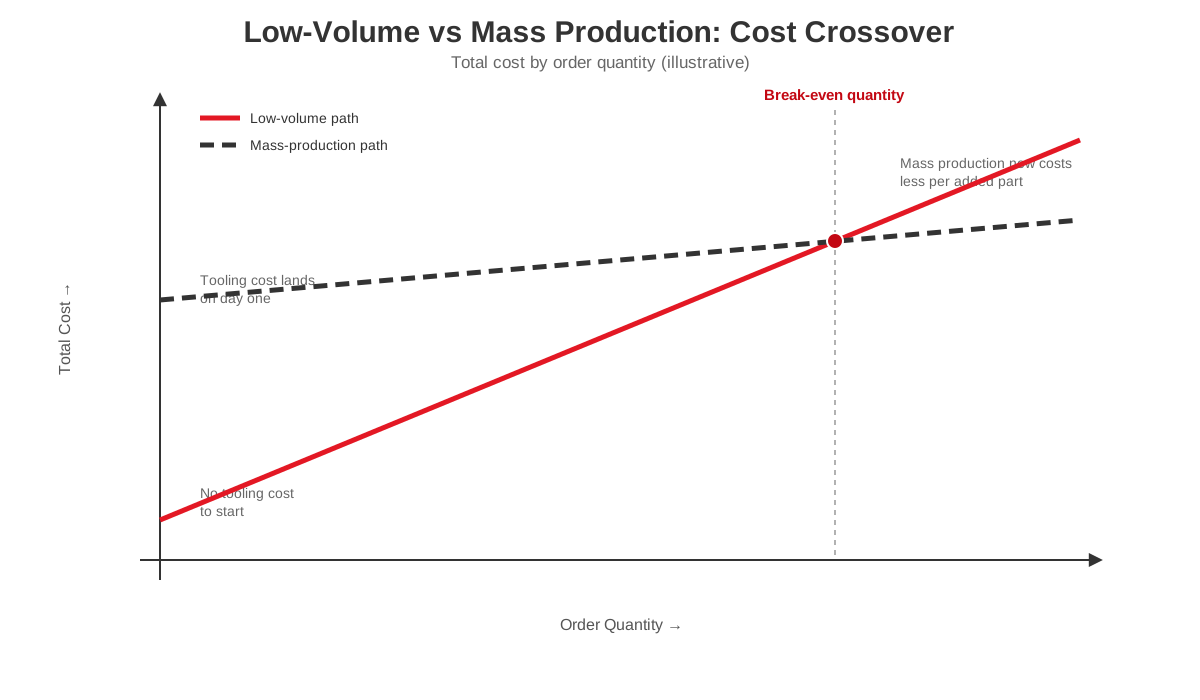
Manufacturing planning also assumes unit cost drops as cumulative quantity rises, since operators and processes become faster with repetition. This is the basis of the learning curve used across manufacturing procurement to anticipate lower unit costs as order quantity increases.
| Cost driver | Low-volume path | Mass-production path |
|---|---|---|
| Tooling investment | Minimal, general-purpose fixturing | Significant, dedicated tooling built for the part |
| Setup cost per part | High, spread across a small batch | Low, spread across a large batch |
| Design-change exposure | Low, no stranded tooling if the drawing changes | High, a revision can strand fixturing spend |
| Best fit | Validation, testing, modest or uneven demand | Locked design, proven and repeating demand |
Lead Time and Quality Consistency
Low-volume orders are usually the fastest route to finished parts, since there is no dedicated tooling to design and build first. Standard lead time for a CNC order runs 10 to 15 days, with 7 days achievable on a small prototype order.
Mass production carries a longer front-end lead time, because fixturing has to be designed, built and proven before the first production batch runs. Once that fixturing is in place, cycle time per part drops, and repeat batches move faster than an equivalent low-volume order would.
Quality consistency is managed differently across the two paths as well. Statistical process control and similar process-development methods are most effective on high-volume, continuous-flow production, where a large sample size makes drift visible early. Low-volume runs rely more on first-article inspection and in-process checks, since a short run does not generate enough data for a statistical trend.
The same quality system applies either way. Certifications including ISO 9001, ISO 14001, ISO 13485 and IATF 16949 cover both a small prototype batch and a continuous production line. General tolerances follow ISO 2768 unless a drawing calls out something tighter. Standard shop tolerance runs to ±0.05 mm, with precision work held to ±0.01 mm on either path.
A Practical Framework for Choosing a Path
Three questions decide which path fits a part best.
- Order pattern. A one-off, a handful of validation units, or a demand curve that has not yet stabilized points toward low-volume machining. A confirmed repeat order or a signed supply schedule points toward mass production.
- Part maturity and revision stability. A design still moving through validation rounds is not ready for dedicated tooling, since a revision can strand that investment. A frozen design that has cleared testing is a better candidate for tooling built specifically for it.
- Tooling investment tolerance. Low-volume machining avoids upfront tooling cost entirely, trading it for a higher cost per part. Mass production asks for capital committed before the first production part ships, in exchange for a lower cost per part once running.
When to Move From Low-Volume Into Mass Production
A few signals suggest a part has outgrown low-volume machining. Repeat orders arriving on a predictable schedule is one. A design that has cleared several validation rounds without a revision is another. Volume climbing to a level where general-purpose fixturing adds real cycle time to every part is a third.
At that point, dedicated tooling and fixturing usually pay for themselves within a reasonable number of batches, and the move into mass production becomes a capital decision rather than a manufacturing one. Low-volume and mass production both run under the same shop and the same quality system, so moving from one path to the other does not mean changing supplier.
Not sure which path fits a part? Send the details for a scoped recommendation — get an instant quote.
Frequently Asked Questions
What is considered low-volume CNC machining?
Low-volume, or bridge, production covers batches used for design validation, market testing, or a modest recurring demand that does not justify dedicated tooling. Machining relies on general-purpose fixturing and standard cutting programs rather than parts built specifically for the job. It suits designs that may still change and orders placed before a commitment to mass-production tooling.
Can low-volume CNC production scale to mass production?
Yes. A part that starts as a low-volume CNC run can move into mass production once the design is stable and demand becomes predictable. The shop then builds dedicated fixturing and optimizes the process for repeat cycles. Many programs deliberately start low-volume to validate a design before committing capital to tooling.
Is low-volume CNC machining cheaper than injection molding?
For plastic parts, low-volume CNC machining is usually cheaper below the quantity where a mold pays for itself, since CNC needs no tooling investment. Injection molding carries a high upfront mold cost but a very low cost per part once running. The crossover point depends on part geometry, material and quantity, so a direct comparison needs a real quote from both processes.
Where does production take place?
Production runs in-house, with machining, finishing and inspection handled under one roof. The same quality system, certified to ISO 9001, ISO 14001, ISO 13485 and IATF 16949, applies whether the order is a small prototype batch or a continuous production run.
What is the minimum and maximum order quantity?
There is no minimum order quantity, a single one-piece prototype is quoted and machined the same way as a production batch. For a full low-volume production run, the most economical batch size depends on part geometry, material and tooling needs, so there is no single figure that fits every job; send drawing details for a scoped quote and a batch-size recommendation. On the upper end, capacity scales into continuous mass-production runs, with dedicated tooling and fixturing built once volume and design stability justify the investment.
How do you guarantee quality and consistency?
Every order goes through in-process and first-article inspection, under the same certified quality system (ISO 9001, ISO 14001, ISO 13485 and IATF 16949) regardless of batch size. Low-volume runs lean on first-article and in-process checks; longer, continuous runs add statistical process control, which becomes more effective as sample size grows. Both paths are backed by documented inspection records available on request.