Every 90° edge on a CNC drawing has to become either a rounded fillet or a flat chamfer — the choice affects strength, cost, and cycle time more than most designers expect. Here's how to call it out correctly.
What a Fillet and a Chamfer Actually Are
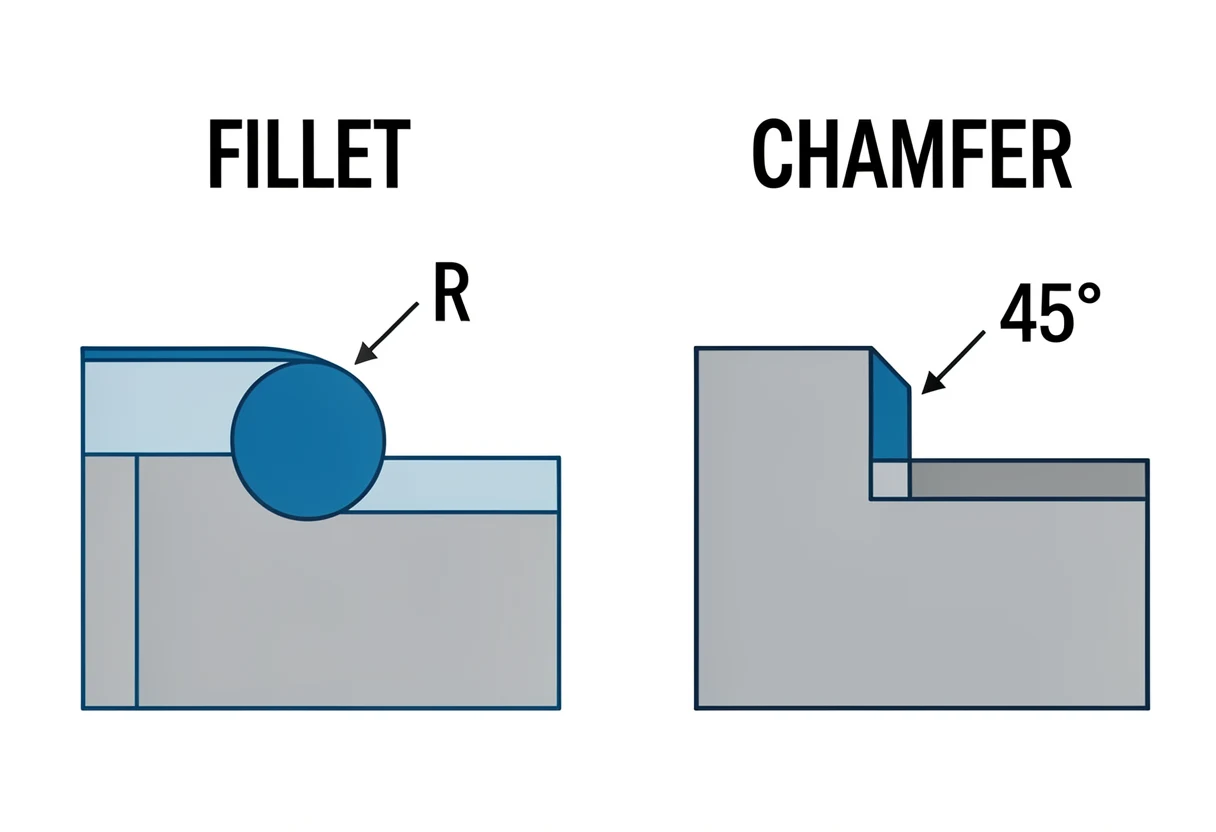
A fillet is a rounded, constant-radius transition machined into a corner. On an internal corner it's cut with a ball-end mill or a corner-radius end mill, and the radius of the tool has to be equal to or smaller than the radius you're producing — you cannot machine an internal fillet with a cutter bigger than the callout. On an external edge, a fillet can be milled with a radius cutter or a form tool in one pass along the profile.
A chamfer, by contrast, is a flat, angled cut — almost always 45°, though 30° and 60° show up on specific designs. It's typically produced with a dedicated chamfer mill, a countersink, or even the lead angle of a standard end mill run along the edge. Because a chamfer is a single flat plane rather than a curved surface, it's usually a faster, more forgiving operation on the same CNC milling setup that's already machining the rest of the part.
Stress Concentration: Fillet vs Chamfer
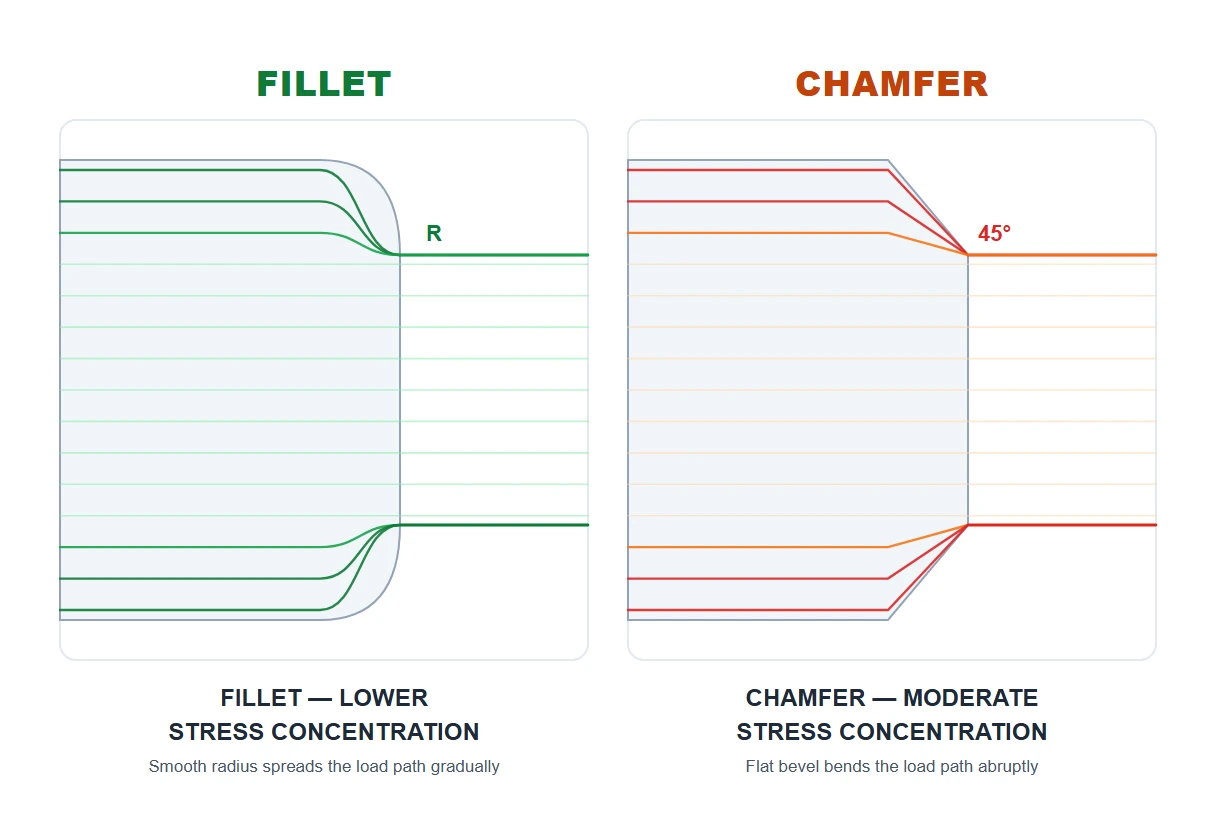
A sharp 90° corner is the worst-case stress riser on any part — load lines have to change direction abruptly, and that abrupt change is where fatigue cracks start. A fillet is the strongest fix because a continuous, smoothly curved radius lets the load path bend gradually instead of snapping direction, which lowers the stress concentration factor the most. This matters most on parts that see cyclic loading, vibration, or repeated flexing.
A chamfer also removes the sharp corner, so it's a real improvement over a square edge, but it does so with two new flat-to-angle transitions rather than one smooth curve — those transitions are still mild stress risers, just smaller ones than a 90° corner. On structurally critical or fatigue-prone geometry, especially deep pockets or tight internal features handled under our complex-geometry machining work, we'll usually recommend specifying a fillet over a chamfer even though it costs a bit more to cut.
Cost, Cycle Time, and How to Call It Out
Chamfers are almost always the cheaper, faster option: a single-pass chamfer mill or countersink works on internal and external edges alike with minimal programming, so it adds very little cycle time. Internal fillets cost more because the cutter radius has to match or beat the callout — a tight internal radius may force a smaller, slower-feeding tool, or a dedicated finishing pass that a chamfer never needs.
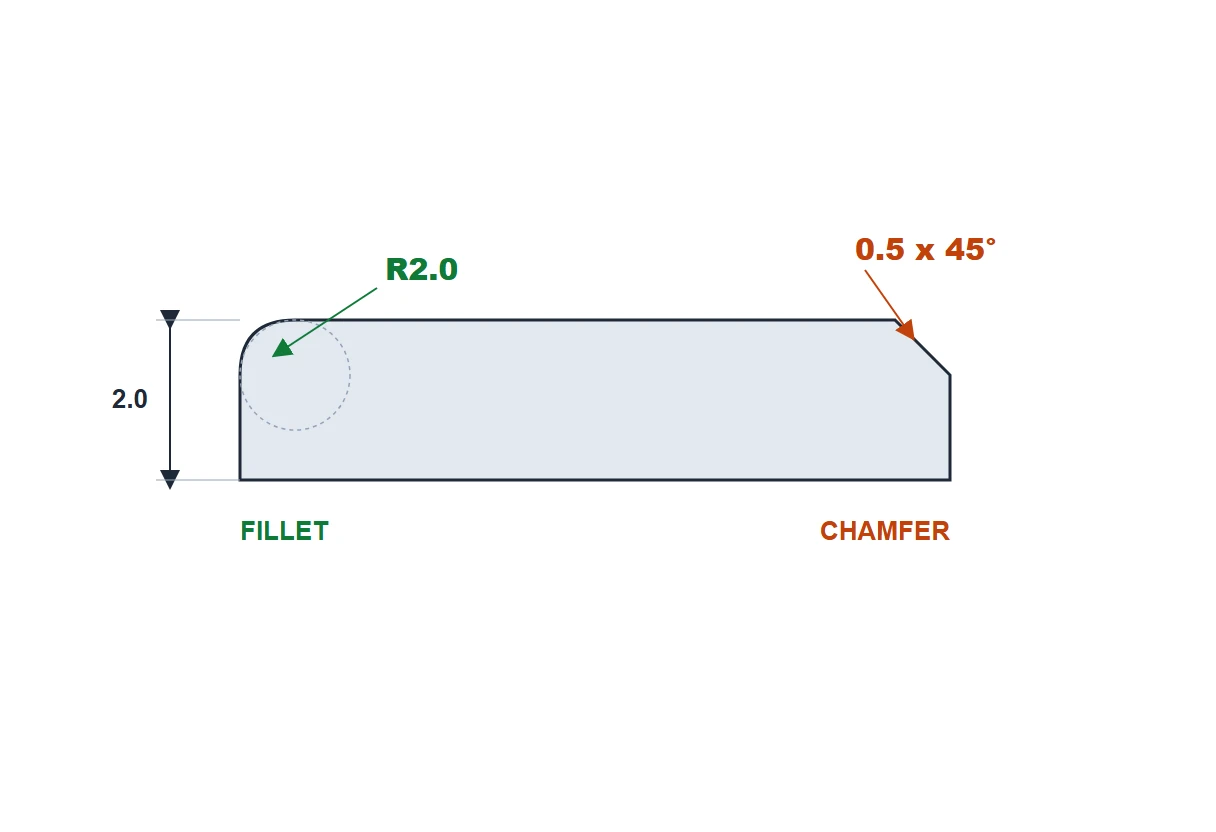
On the drawing, call out a fillet with the radius symbol and a tolerance (e.g. R2.0 ±0.1) wherever the radius is functional — sealing surfaces, mating parts, or fatigue-critical corners. Call out a chamfer as a linear-by-angular dimension (e.g. 0.5 x 45°) for deburring, assembly lead-ins, or any edge where the flat bevel doesn't need to match another part's profile. If you're not sure which your geometry needs, our milling team can flag it during design-for-manufacturing review before the first cut is made.
Get Your Fillet or Chamfer Callouts Machined Right
- 12–24h quote turnaround — send your drawing with fillet and chamfer callouts and get pricing, lead time, and DFM feedback back fast.
- ISO 9001:2015 certified — every edge treatment, radius, and chamfer dimension is inspected and documented against your drawing at every production stage.
- NDA-ready & confidential — your CAD files, tolerances, and edge-treatment specs stay protected under NDA from quote through delivery.
- No fixed MOQ — prototype a single part to validate a fillet or chamfer callout, then scale to full production.
Frequently Asked Questions
What is the difference between a fillet and a chamfer?
A fillet is a rounded, constant-radius transition machined into an internal or external corner, typically cut with a ball-end mill or a corner-radius end mill. A chamfer is a flat, angled cut — usually 45° — that bevels a sharp edge, typically cut with a chamfer mill, countersink, or single-point tool. Both remove a sharp 90° edge, but a fillet is curved and a chamfer is flat.
Why use a fillet instead of a chamfer in CNC machining?
Fillets are specified when the part needs to resist cyclic loading or vibration, because a continuous radius spreads stress across a wider area than a flat bevel. They are also required wherever a mating radius, seal, or fitted component needs a matched round profile. If the design is purely for handling safety or a lead-in for assembly, a chamfer usually does the job for less machining time.
Does a fillet or a chamfer reduce stress concentration better?
A fillet reduces stress concentration more effectively. A sharp corner has the highest stress concentration factor; a fillet with a generous, continuous radius lowers that factor the most because the load path curves smoothly instead of changing direction abruptly. A chamfer removes the sharp corner too, but because it introduces two new flat-to-angle transitions, it still leaves smaller stress risers at each end of the bevel — better than a sharp corner, worse than a true fillet.
Is a chamfer cheaper to machine than a fillet?
Generally yes. A chamfer can usually be cut in a single pass with a standard chamfer mill or countersink on almost any edge, internal or external, with minimal programming. A fillet on an internal corner needs a cutter radius equal to or smaller than the specified radius, which can mean a smaller, slower-feeding tool or an added operation — so fillets typically add cycle time and cost compared to an equivalent chamfer.